
Climate Controlled Projector Enclosures for Stadium Projection Mapping
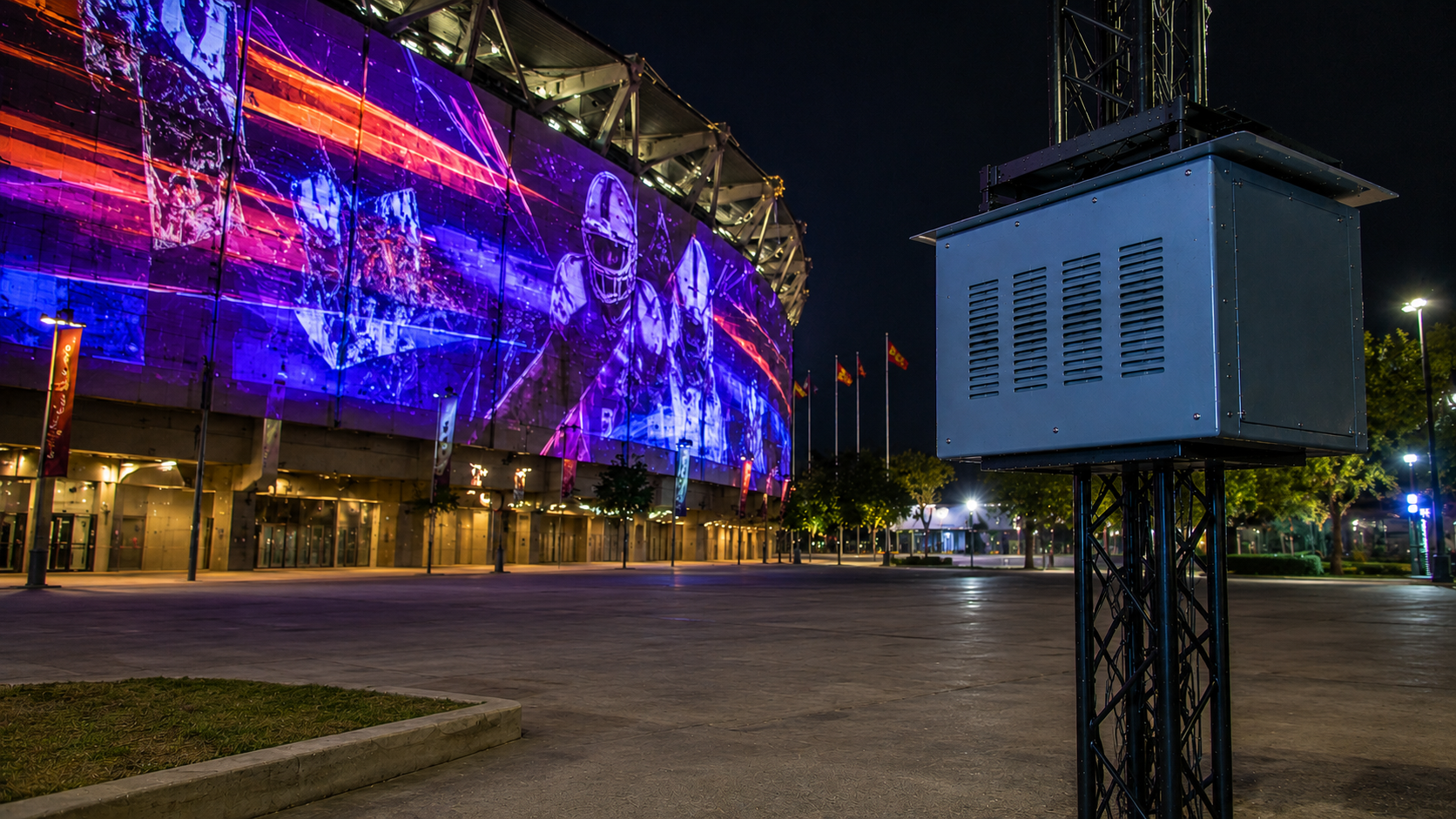
Climate Controlled Projector Enclosures for Stadium Projection Mapping
Climate controlled projector enclosures for stadium projection mapping help protect projectors used in arenas, sports venues, concourses, fan zones, exterior facades, field entrances, sponsor activations, and large public event spaces. Stadium projection mapping can create huge visual moments, but the projector setup has to survive demanding conditions.
Large venues are not gentle environments.
Projectors may face dust, heat, rain, humidity, wind, vibration, crowd traffic, long runtimes, and tight event schedules. In addition, stadium shows often depend on precise timing and alignment. If the projector shifts, overheats, or fails during an event, the problem becomes visible fast.
Because of that, the enclosure should be part of the production plan from day one.
Stadium Mapping Needs Reliability at Scale
Projection mapping in a stadium or arena often supports a major guest experience. It may be used for player entrances, sponsor visuals, fan engagement, opening ceremonies, exterior building projections, halftime moments, or seasonal events.
That means reliability matters.
Unlike a small private install, a stadium show may be seen by thousands of people. Therefore, the projector system needs to stay aligned, protected, and ready throughout setup, rehearsal, showtime, and teardown.
A climate controlled enclosure helps protect the projector while supporting a stable installation position. As a result, production teams can reduce avoidable risk and focus on the show.
Stadium Environments Are Hard on AV Equipment
Sports venues combine open-air exposure, public traffic, and long operating schedules. Even indoor arenas can have dusty loading areas, changing temperatures, and heavy event activity.
Common risks include:
- Heat from daytime sun, concrete, rooftops, and hardscape
- Rain or wind-driven moisture in open-air venues
- Dust from crowds, staging, loading docks, and landscaping
- Humidity during evening events
- Vibration from crowds, music, and nearby structures
- Tampering or accidental contact in public-facing areas
- Limited service windows before events
- Long runtime demands during shows and rehearsals
ProjectorEnclosure.com describes the Defender Series as climate controlled projector enclosures built for outdoor and harsh-environment installations. These enclosures combine weather-resistant construction, insulation, secure access, active climate control, and service-friendly design.
That combination fits stadium applications where standard projector housing is not enough.
Climate Control Supports Long Event Runtimes
Stadium projection systems rarely run for only a few minutes. Crews may power up early for testing, alignment, rehearsal, preshow content, the main event, halftime visuals, sponsor loops, and post-event playback.
That extended runtime creates heat. Meanwhile, outdoor venues may cool quickly after sunset, and humidity may rise during evening events.
A climate controlled enclosure helps create a more stable operating space around the projector. In turn, the system can better support long event schedules and changing conditions.
For venue teams, this matters because show equipment has to work on event time. There is no room for “almost ready” when the crowd is already seated.
Defender Series Enclosures for Stadium Projection Mapping
The Defender Series is designed for projector protection where standard housings are not enough. ProjectorEnclosure.com states that these climate controlled projector enclosures help protect projection equipment from changing temperatures, humidity, rain, snow, dust, and public-facing installation risks.
That makes Defender-style enclosures useful for:
- Stadium exterior projection mapping
- Arena entrance visuals
- Player tunnel effects
- Fan zone projection displays
- Sponsor activation mapping
- Outdoor concourse visuals
- Field or court entrance moments
- Large event ceremonies
- Seasonal stadium projections
- Temporary and permanent venue installs
In addition, custom sizing, finish options, mounting support, lens clearance adjustments, access panel changes, and project-specific cable routing can help the enclosure fit the venue layout.
Public Venues Need Secure Projector Protection
Stadiums and arenas are public-facing spaces. Guests, staff, vendors, production crews, cleaning teams, and security personnel may move near AV equipment constantly.
Because of that, projector security matters.
A climate controlled enclosure with durable housing and locking access can help protect the projector from tampering, impact, and accidental contact. It also helps make the installation look more professional.
This is especially important for temporary event setups where equipment may sit on truss, platforms, rooftops, concourses, or near production zones.
Dust and Debris Can Affect Image Quality
Large venues move a lot of air and activity. Crowd movement, vehicle traffic, staging, turf, concrete dust, wind, and production work can all push debris toward AV equipment.
Dust can affect projector performance and airflow. BenQ notes that dusty environments can impact projectors and recommends protecting them from dust exposure.
https://www.benq.com/en-us/knowledge-center/knowledge/what-can-you-do-to-protect-your-school-projectors-from-dust.html
For projection mapping, dust can also reduce image quality. If particles collect near the projection path, the mapped image may lose sharpness or brightness.
A climate controlled enclosure helps reduce direct exposure and supports a cleaner operating environment.
Moisture Planning Matters in Open-Air Venues
Open-air stadiums and outdoor fan zones can face rain, fog, humidity, and condensation. Even covered areas can see moisture move through the space during storms or evening temperature changes.
The U.S. EPA explains that unmanaged moisture can affect materials and systems over time.
https://www.epa.gov/sites/default/files/2014-08/documents/moisture-control.pdf
Although that guidance focuses on buildings, the same principle applies to outdoor AV systems. Moisture should be planned for before it becomes a reliability problem.
A climate controlled projector enclosure helps protect sensitive projector components from the unpredictable conditions found in large venues.
Harsh Weather Should Not Stop the Show
Stadium events often happen on fixed dates. Weather does not always cooperate, but the show still needs to run when possible.
ProjectorEnclosure.com discusses projection mapping in harsh conditions and explains that Defender climate controlled enclosures help make mapping possible in rain, snow, or heat.
That matters for sports venues because production schedules are strict. A projector problem can affect sponsors, fans, broadcast moments, and event operations.
Better enclosure planning reduces that risk.
Alignment Is Critical in Large-Scale Mapping
Stadium projection mapping may target large surfaces such as building facades, tunnel entrances, seating structures, scoreboards, exterior walls, concourse features, or scenic stage elements.
Because these surfaces are often large and complex, alignment must be planned carefully.
Before choosing the enclosure location, confirm:
- Projection surface size
- Projector model
- Lens model
- Throw distance
- Mounting height
- Beam path
- Crowd sightlines
- Broadcast camera angles
- Service access
- Cable routing
- Weather exposure
- Security requirements
ProjectorEnclosure.com recommends sharing projector model, lens model, dimensions, location, exposure level, temperature range, humidity concerns, mounting method, access direction, finish preference, and clearance limits before sizing a climate controlled enclosure.
With those details, SSI can help review fitment, airflow, lens clearance, access, and enclosure direction.
Cable Routing Needs Venue-Level Planning
Stadium projection mapping often requires power distribution, signal routing, network control, media servers, backup systems, and safe cable paths through active event areas.
Because of that, cable planning should happen early.
A clean setup should consider:
- Power source location
- Signal and network paths
- Cable ramps
- Weather-safe routing
- Media server location
- Backup playback systems
- Technician access
- Guest safety
- Load-in and load-out paths
- Service loops
ProjectorEnclosure.com lists project-specific cable and power routing as a custom option for climate controlled enclosure projects.
That flexibility helps production teams build cleaner, safer, and more dependable stadium mapping systems.
Service Access Protects Event Schedules
Venue crews need practical service access. If a projector needs inspection, adjustment, or troubleshooting, the enclosure should allow technicians to work quickly and safely.
A good enclosure layout should allow teams to:
- Open access panels safely
- Inspect vents and filters
- Check power and signal connections
- Adjust projector position
- Clean projection windows if used
- Remove equipment when required
- Work around active venue schedules
- Keep public areas protected
Good service access reduces downtime. More importantly, it helps prevent small issues from becoming event-day failures.
Final Takeaway
Stadium and arena projection mapping needs high reliability, stable alignment, long-runtime support, public-facing protection, weather resistance, and practical service access. Heat, dust, humidity, rain, crowd activity, and strict schedules can all affect projector performance.
Climate controlled projector enclosures for stadium projection mapping help protect the projector while supporting a stronger venue experience. For sports venues, arenas, fan zones, sponsor activations, and large event projections, a Defender Series enclosure gives the system a more reliable foundation.
Call 888-631-5880 or visit ProjectorEnclosure.com to review your projector model, lens, venue layout, mapped surface, and environmental conditions.
Sources
ProjectorEnclosure.com — Climate Controlled Projector Enclosures
https://projectorenclosure.com/climate-controlled-projector-enclosures/
ProjectorEnclosure.com — Projection Mapping in Harsh Conditions
https://projectorenclosure.com/mapping-harsh-environments/
BenQ — Protecting Projectors From Dust
https://www.benq.com/en-us/knowledge-center/knowledge/what-can-you-do-to-protect-your-school-projectors-from-dust.html
U.S. EPA — Moisture Control Guidance
https://www.epa.gov/sites/default/files/2014-08/documents/moisture-control.pdf
ProjectorEnclosure.com — The Defender Series Enclosures
https://projectorenclosure.com/store/the-defender-series-enclosures/
ProjectorEnclosure.com — Projector Enclosures Overview
https://projectorenclosure.com/projector-enclosures/
Element14 — How Sunlight, Humidity, and Moisture Affect Electronics
https://community.element14.com/learn/learning-center/the-tech-connection/b/blog/posts/how-do-sunlight-humidity-and-moisture-affect-electronics
SSI Displays — Projector Enclosures
https://ssidisplays.com/projector-enclosures/
Fan-Cooled Projector Enclosure for Interactive Projection Mapping