
Choosing the Right Climate Controlled Enclosure for a Backyard Outdoor Home Theatre
Climate Controlled Enclosure for Outdoor Home Theatre Projectors
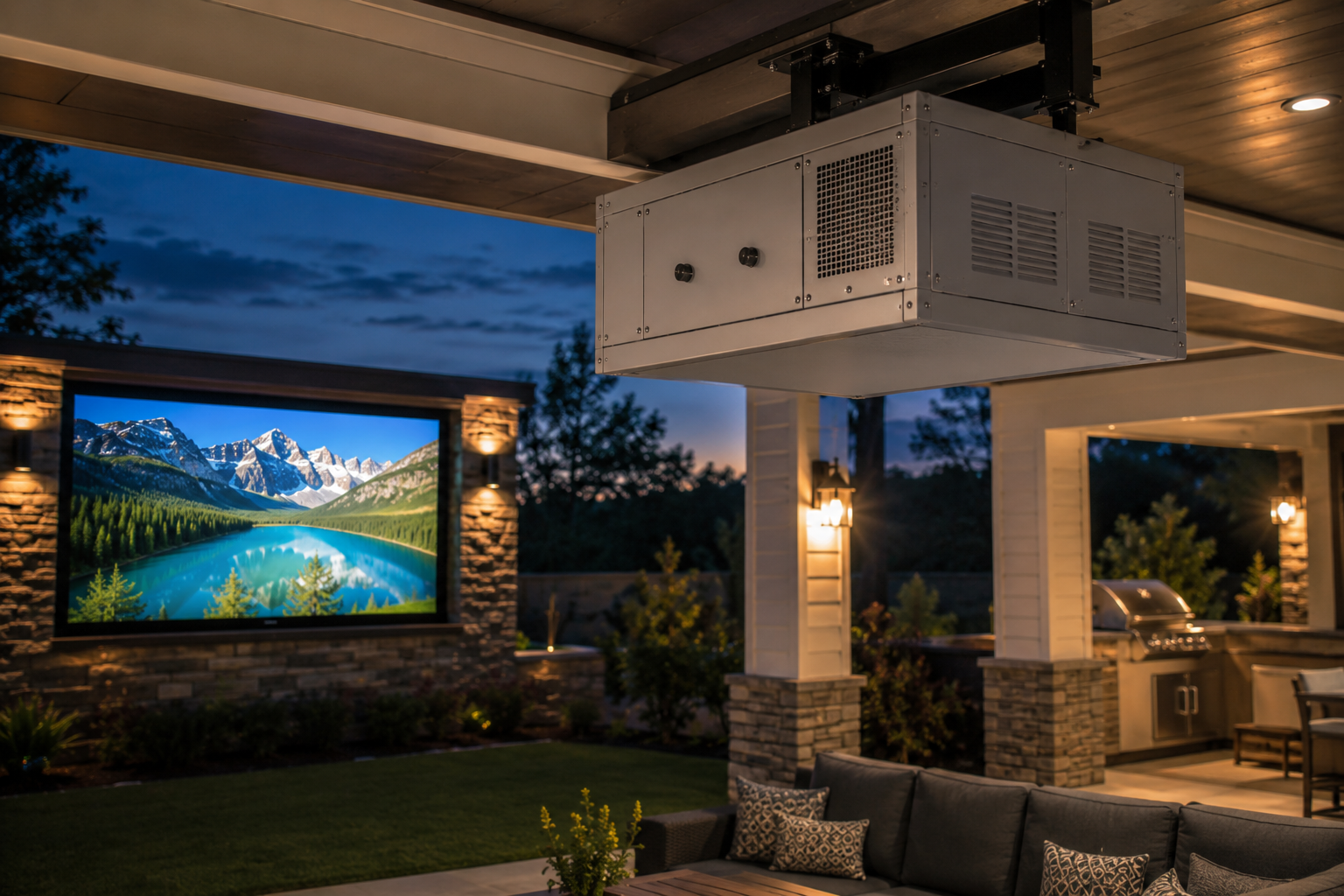
A climate-controlled enclosure for outdoor home theatre installations helps protect the projector before, during, and after every movie night. Backyard theatres may look simple from the seating area, but behind the scenes, the projector has to deal with heat, humidity, dust, rain, insects, temperature swings, and long idle hours outside.
Because of that, choosing the right enclosure matters just as much as choosing the projector.
A projector may have enough brightness for a backyard screen. However, it still needs the right housing to survive outdoor conditions. The wrong enclosure can trap heat, limit airflow, block service access, or create fitment problems with the lens. A properly selected enclosure, on the other hand, helps the entire outdoor theatre feel cleaner, safer, and more permanent.
Start With the Projector, Not the Enclosure
Every enclosure decision should begin with the projector model. Dimensions, power draw, airflow path, lens length, mounting position, and service access all affect enclosure sizing.
Before requesting a recommendation, gather these details:
- Projector make and model
- Lens model
- Projector body dimensions
- Total depth with the lens installed
- Power consumption
- Intake and exhaust vent locations
- Mounting style
- Required throw distance
- Screen size and location
- Installation environment
ProjectorEnclosure.com recommends sending the projector model, lens model, dimensions, location, exposure level, temperature range, humidity concerns, mounting method, access direction, finish preference, and clearance limits before sizing a Defender Series enclosure.
With that information, the enclosure recommendation becomes practical instead of generic. In addition, it helps confirm lens clearance, airflow, service access, and mounting direction before the project gets too far along.
Confirm the Lens Direction and Projection Path
The projector must aim cleanly at the screen. That sounds obvious, yet it becomes a common issue when the enclosure gets mounted under a patio cover, pergola beam, balcony, soffit, or outdoor structure.
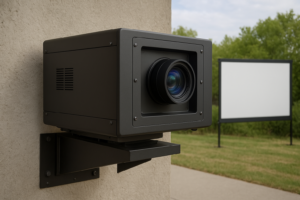
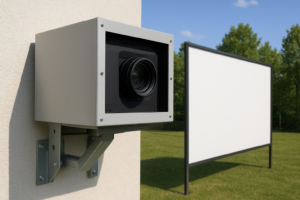
For most backyard theatre layouts, the enclosure should sit behind or above the seating area with the projector aimed toward the screen. Even when the enclosure is shown from the rear, the lens side should still face the projection surface.
Good planning helps avoid:
- Lens obstruction
- Poor projector alignment
- Awkward mounting angles
- Unwanted keystone correction
- Service doors blocked by beams or walls
- Cable exits on the wrong side
- Airflow paths aimed into tight spaces
As a result, the installation looks cleaner and performs better. Homeowners want the theatre to feel built-in, not improvised.
Match Climate Control to the Outdoor Environment
Outdoor home theatres do not all face the same conditions. A covered patio in a mild climate may need different protection than a fully exposed poolside install in a hot, humid region.
Still, many residential outdoor theatre spaces face enough environmental stress to justify climate control. Heat, cold, rain, humidity, dust, and weather exposure can all affect projector performance and lifespan.
The Defender Series is described by ProjectorEnclosure.com as a climate controlled projector enclosure system built for outdoor and harsh-environment installations. It combines weather-resistant construction, insulation, secure access, active climate control, and service-friendly design.
Therefore, backyard theatres that remain installed full-time need more than a cover. They need an enclosure that supports the projector’s operating environment.
Covered Patio Does Not Always Mean Protected
Many homeowners assume a roof or pergola provides enough protection. Unfortunately, covered does not mean controlled.
Wind can drive rain sideways. Dust and pollen can still enter the projector. At the same time, humidity can rise overnight. Heat can also build under patio covers, especially during summer afternoons.
Outdoor AV equipment often sits unused for long stretches as well. During those idle periods, the projector still faces moisture, insects, temperature swings, and airborne debris.
For that reason, a climate controlled enclosure helps solve the full-time exposure problem. Instead of only shielding the projector during operation, it helps protect the system while it waits for the next event.
Choose Defender Series for Harsh or Permanent Installs
For backyard home theatres that need a serious long-term solution, the Defender Series is the strongest fit. ProjectorEnclosure.com positions Defender enclosures for outdoor projector protection where standard housing is not enough. The site also states that these enclosures help protect valuable projection equipment from changing temperatures, humidity, rain, snow, dust, and public-facing installation risks.
That makes Defender-style climate controlled enclosures a smart choice for:
- Permanent backyard theatres
- Poolside projection systems
- Outdoor kitchens and lounge areas
- Pergola-mounted projectors
- Coastal or lakeside homes
- Hot-weather patios
- Humid climates
- High-value laser projectors
- Large-format backyard screens
- Projection mapping on homes or walls
A basic cover may work for temporary setups. However, permanent outdoor home theatres need a real enclosure strategy.
Look at Service Access Before Installation
A great enclosure should protect the projector without making future service difficult. Eventually, someone may need to clean the lens area, check cables, inspect power, access controls, or remove the projector.
Therefore, service access should be planned before mounting.
Check these points early:
- Can the access door open fully?
- Is there enough room to remove the projector?
- Can power be reached safely?
- Are filters, vents, or panels accessible?
- Will the mount block the service side?
- Can a technician work without removing the whole enclosure?
ProjectorEnclosure.com describes the Defender Series as service-friendly, which matters for outdoor installations where access can become awkward after construction finishes.
Smart access planning saves time later. More importantly, it keeps routine inspection from turning into a major teardown.
Consider Security and Tamper Protection
Outdoor home theatres often place expensive equipment in semi-public or visible areas. Even in residential backyards, a projector can still be exposed to guests, renters, service workers, children, pets, or accidental impact.
A climate controlled enclosure adds another layer of protection. The Defender Series includes secure access and durable housing designed to help protect equipment from tampering, impact, and theft concerns.
For high-end residential projects, that matters. The enclosure protects the projector from both the weather and the real world.
Plan the Finish Around the Backyard Design
Outdoor theatres should look intentional. A bulky box in the wrong color can distract from the patio design. In contrast, a well-finished enclosure can blend into the structure.
Depending on the project, custom options may include:
- Custom enclosure dimensions
- Custom color or powder coat finish
- Modified climate-control layout
- Projector and lens clearance adjustments
- Custom mounting support
- Locking access panel changes
- Branding, vinyl wrap, or camouflage finishes
- Project-specific cable and power routing
ProjectorEnclosure.com lists these types of custom options for climate controlled projector enclosure projects.
Because of that, homeowners, AV integrators, and builders can treat the enclosure as part of the architecture rather than an afterthought.
Avoid These Common Buying Mistakes
Several mistakes can turn a good projector into a frustrating outdoor system.
One major mistake is choosing an enclosure based only on projector width, height, and depth. That approach ignores lens clearance, airflow, cable exits, service access, heat output, and mounting direction.
Another common problem is using an indoor box outdoors. Indoor hush boxes and fan-cooled housings may work beautifully in controlled environments. However, harsh outdoor spaces need stronger protection.
Humidity also gets underestimated. Rain grabs attention, yet moisture in the air can create long-term issues. The U.S. EPA’s moisture control guidance explains that moisture management matters because uncontrolled moisture can affect materials, systems, and indoor environments over time.
Outdoor electronics deserve that same level of planning.
Best Recommendation for Homeowners
For a permanent outdoor home theatre, start with the projector specs and the installation environment. Then, choose a climate controlled enclosure that supports the projector’s heat load, airflow needs, lens direction, service access, and outdoor exposure level.
A Defender Series climate controlled enclosure is the right direction when the projector will face heat, cold, humidity, dust, rain, snow, or full-time outdoor installation risk.
Call 888-631-5880 or visit ProjectorEnclosure.com before ordering. SSI can help confirm fitment and recommend the correct enclosure style for the projector, lens, and backyard layout.
Final Takeaway
The right enclosure protects more than the projector. It protects the entire outdoor theatre experience. A climate controlled enclosure for outdoor home theatre installations helps homeowners build a cleaner, more reliable, more permanent backyard cinema system.
Choose the enclosure around the projector, the environment, the lens direction, and the service plan. That is how a backyard projector setup becomes a true outdoor theatre.
Sources
ProjectorEnclosure.com — Climate Controlled Projector Enclosures
https://projectorenclosure.com/climate-controlled-projector-enclosures/
ProjectorEnclosure.com — The Defender Series Enclosures
https://projectorenclosure.com/store/the-defender-series-enclosures/
SSI Displays — Projector Enclosures
https://ssidisplays.com/projector-enclosures/
ProjectorEnclosure.com — 5 Questions to Ask Before Choosing a Projector Enclosure
https://projectorenclosure.com/choosing-outdoor-enclosure/
U.S. EPA — Moisture Control Guidance
https://www.epa.gov/sites/default/files/2014-08/documents/moisture-control.pdf
ProjectorEnclosure.com — Projector Enclosures Overview
https://projectorenclosure.com/projector-enclosures/
Element14 — How Sunlight, Humidity, and Moisture Affect Electronics
https://community.element14.com/learn/learning-center/the-tech-connection/b/blog/posts/how-do-sunlight-humidity-and-moisture-affect-electronics
BenQ — Protecting Projectors From Dust
https://www.benq.com/en-us/knowledge-center/knowledge/what-can-you-do-to-protect-your-school-projectors-from-dust.html