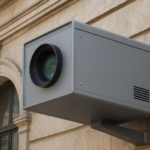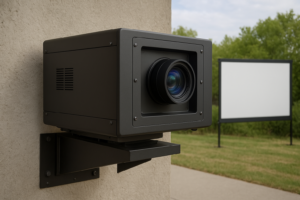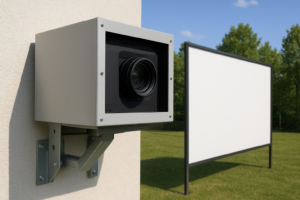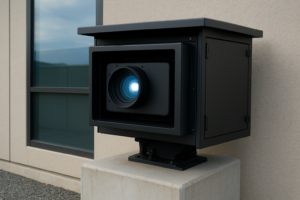

Fan-cooled projector enclosure installed in an event venue with the projector lens facing the screen.
Fan-Cooled Projector Enclosures for Attractions and Immersive Spaces
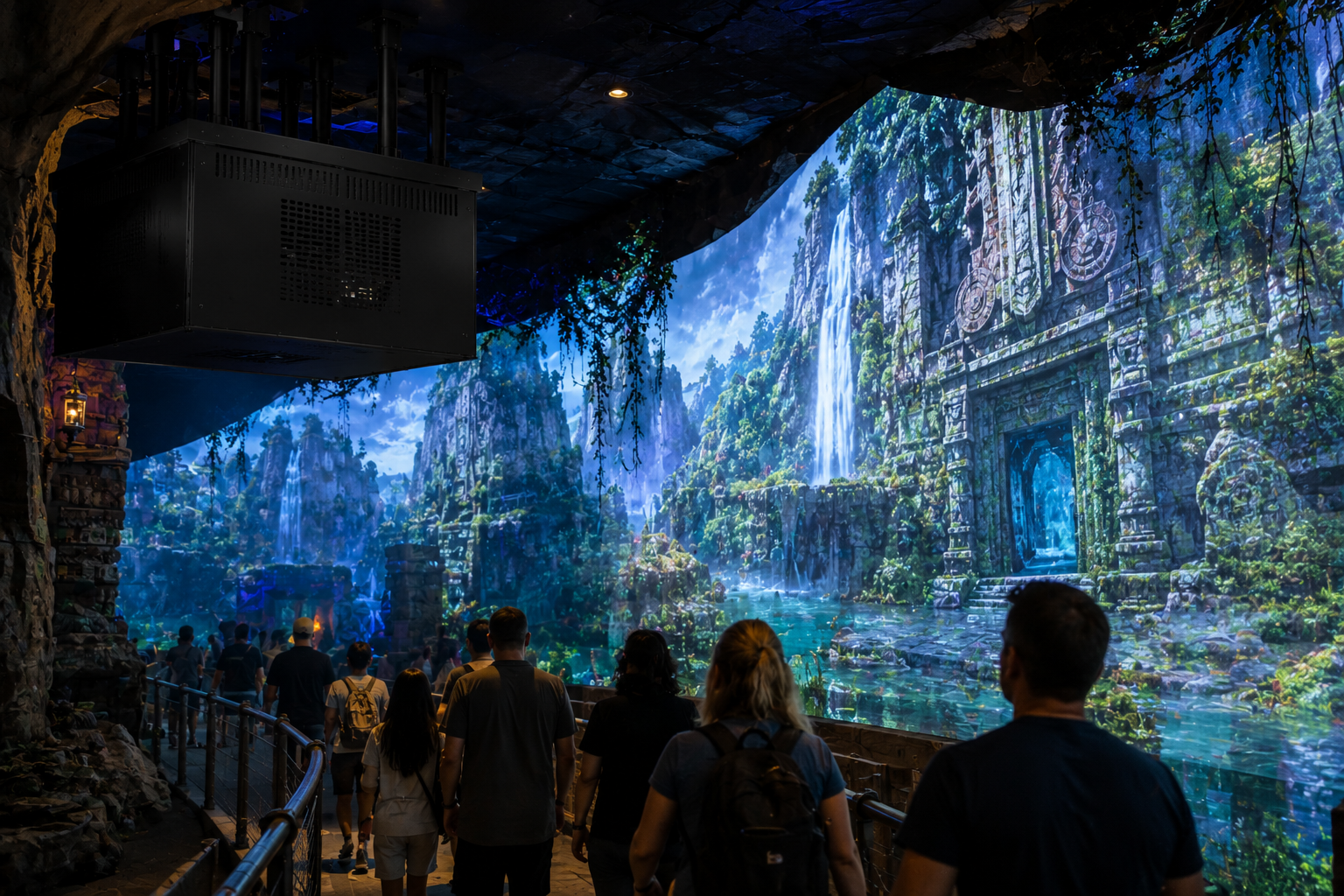
A fan-cooled projector enclosure gives theme parks, museums, aquariums, zoos, visitor centers, branded attractions, and immersive entertainment venues a cleaner way to protect projector equipment.
These spaces depend on reliability. A projection effect may support a preshow, queue experience, dark ride, walkthrough exhibit, interactive room, mapped wall, seasonal overlay, or branded photo moment. Therefore, the projector does more than display an image. It helps drive the guest experience.
However, attractions can be tough on AV equipment.
Guests move through the space all day. Staff clean around the system. HVAC moves dust through the room. Show lighting creates heat. In addition, projection systems may run for long hours with limited downtime.
Because of that, a projector should not hang exposed in a guest-facing attraction.
A fan-cooled projector enclosure provides built-in fan cooling and a defined housing. Attraction teams should confirm fit, airflow, service access, and site conditions.
Why Attractions Need Projector Protection
Attractions run differently than standard conference rooms or classrooms. They often repeat the same experience all day, every day. A projector may operate during open hours, rehearsal windows, private events, seasonal overlays, and maintenance testing.
In addition, many attractions hide AV equipment inside themed spaces. A projector may sit near scenic walls, truss, ceiling structures, queue lines, props, projection windows, or service catwalks. Therefore, dust, heat, access, and alignment all matter.
Projection also plays a growing role in themed entertainment. IAAPA promotes immersive experiences and technology innovation across the attractions industry, while Panasonic’s recent IAAPA-focused article highlights projection mapping as part of immersive booth and attraction storytelling.
Projector placement, ventilation, alignment, and visual integration are part of show planning.
A fan-cooled enclosure helps reduce those risks.
Projection Supports More Than One Attraction Type
Projection works across many attraction formats. It can support large scenic backdrops, animated environments, interactive rooms, character moments, preshow visuals, mapped props, museum storytelling, and branded experiences.
For example, projection mapping can place images onto irregular shapes, non-flat surfaces, buildings, landmarks, and scenic environments. Barco describes projection mapping as a way to use light and color on irregular surfaces, while ProjectorCentral explains that projection mapping can transform objects, venues, stadiums, concert halls, and building exteriors.
Therefore, projectors often sit in non-standard locations. They may aim at a cave wall, dome surface, theater scrim, themed doorway, exhibit wall, animatronic scene, or architectural façade.
That flexibility creates opportunity. However, it also creates installation challenges.
A fan-cooled projector enclosure provides a defined installation option for these environments.
Why Airflow Matters During Long Operating Hours
Projectors generate heat. They also need clean airflow to operate safely.
Epson explains that projector air filters and air vents need cleaning to support ventilation when filters and vents are kept clear. Epson also warns users to check blocked ventilation vents and clogged filters when a projector overheats.
That matters in attractions because many projectors run for long periods. A museum exhibit may run all day. A themed queue may loop content continuously. A dark ride effect may trigger hundreds of times per day. A visitor center may run orientation content from opening to close.
Therefore, the projector needs protection. However, it also needs air.
A random decorative box can trap heat. In contrast, a purpose-built fan-cooled enclosure provides built-in fan cooling within a defined housing.
What a Fan-Cooled Projector Enclosure Does
A fan-cooled projector enclosure gives the projector a ventilated protective housing. Its suitability depends on projector fit, airflow direction, service access, public access, and site conditions.
Approved product documentation identifies built-in fan cooling, durable metal construction, and removable or hinged access panels. Environmental requirements must be checked against documentation for the exact configuration.
Screen Solutions International also lists the Integrator as its fan-cooled enclosure line and explains that SSI offers fan-cooled, climate-controlled, Hush, UST, and cage-style projector enclosure options.
Because of that, fan-cooled enclosures can work well in many indoor, covered, or mild attraction environments.
Use the project review to consider:
- Dust
- Heat buildup
- Guest contact
- Staff contact
- Ceiling debris
- Public-area tampering
- Themed décor contact
- Cable clutter
- Projection alignment issues
- Long daily runtimes
For attractions, that planning can support the show design.
Best Attraction Applications for Fan-Cooled Enclosures
A fan-cooled projector enclosure can support many visitor-facing environments. However, it works best when the projector stays indoors, under cover, or in a mild operating space.
1. Theme Park Queue Lines
Queue lines often use projection to build anticipation before the main attraction. A projector may support animated windows, character briefings, themed maps, environmental effects, or story moments.
However, queues also create constant guest traffic. As a result, projector placement should account for public access, site cleanliness, and accidental contact.
A fan-cooled enclosure can provide a visually contained projector installation.
2. Dark Ride and Walkthrough Effects
Dark rides and walkthrough attractions often use projectors for scene extensions, animated walls, portals, ghosts, weather effects, and interactive moments.
Because these effects depend on alignment, projector alignment should be checked and maintained. If the projector shifts, the mapped effect can lose impact.
Therefore, enclosure access and alignment requirements should be considered during project review.
3. Museums and Science Centers
Museums and science centers often use projection for immersive storytelling, historical environments, interactive exhibits, and educational displays.
These spaces may run projectors for long hours. In addition, they often need clean installations that do not distract from the exhibit. A fan-cooled enclosure can provide a visually contained installation.
4. Aquariums and Zoos
Aquariums and zoos use projection for habitat storytelling, educational rooms, donor experiences, digital maps, and immersive theater spaces.
However, these locations may have humidity, dust, visitor traffic, and unique maintenance needs. Therefore, teams should review each location carefully. A fan-cooled enclosure may work in protected indoor areas. However, exposed or humid spaces may need climate-controlled protection.
5. Branded Attractions and Experience Centers
Brands use projection for product launches, immersive rooms, retail activations, photo moments, and interactive visitor journeys.
In these spaces, presentation matters. A black powder-coated Integrator-style enclosure can help make the projection system look intentional instead of temporary.
Real-World Places Where This Makes Sense
Fan-cooled projector enclosures can help attractions in cities and destinations where immersive entertainment, museums, tourism, and themed environments drive demand.
Orlando, Florida
Orlando has theme parks, hotels, museums, attractions, restaurants, and visitor experiences. Projection can support preshows, queues, exhibit rooms, and seasonal overlays. However, humidity can become a major factor. Therefore, teams should use fan-cooled enclosures only in protected, mild spaces and choose climate-controlled protection for exposed areas.
Las Vegas, Nevada
Las Vegas uses projection in casinos, immersive attractions, lounges, event spaces, restaurants, and branded experiences. Because extreme heat can affect outdoor or semi-outdoor installs, teams should review location conditions carefully.
Los Angeles, California
Los Angeles attractions, studios, museums, and experience centers often use projection for storytelling and branded environments. Fan-cooled enclosures can work well in controlled indoor attractions and covered themed spaces.
New York City, New York
New York museums, observation decks, flagship retail spaces, and immersive venues often use projection to create high-impact visitor moments. Because many venues operate in compact rooms, a visually contained projector installation can help keep the room organized.
London, United Kingdom
London’s museums, heritage attractions, galleries, and branded environments can use projection to transform historic and modern spaces. A clean enclosure can keep the projector installation visually refined.
Dubai, UAE
Dubai’s attractions, malls, museums, hotels, and branded environments often demand premium presentation. However, high temperatures make enclosure selection critical. Exposed locations require review against current documentation for the exact climate-controlled configuration.
Fan-Cooled vs. Climate-Controlled for Attractions
Different attraction spaces need different enclosure types.
A fan-cooled projector enclosure is intended for indoor, covered outdoor, and mild-environment installations. Confirm projector fit, airflow direction, service access, and site conditions.
A climate-controlled projector enclosure works better when the projector faces direct weather, high heat, cold, rain, humidity, or long-term outdoor exposure. ProjectorEnclosure.com explains that climate-controlled enclosures add heating, cooling, and humidity regulation for long-term outdoor exposure and extreme climates.
So, for an indoor queue line or exhibit room, fan-cooled may be the right fit. However, for an outdoor projection show, open-air amphitheater, exposed façade projection, or humid animal habitat area, climate-controlled protection offers the safer path.
Why Attractions Should Avoid DIY Projector Boxes
A themed box may look simple. However, it can create a serious heat problem.
If the box blocks intake or exhaust vents, heat can build up quickly. Then the projector may dim, shut down, trigger warnings, or suffer long-term damage.
Epson Europe notes that overheating warnings may appear when vents get blocked or the air filter becomes clogged.
Therefore, attraction teams should avoid random scenic boxes, decorative covers, and sealed cabinets that restrict airflow.
A purpose-built fan-cooled projector enclosure provides built-in fan cooling and service access. Projection alignment, mounting, power routing, and public access should be confirmed during project review.
That difference matters in attraction environments where the show has to work every time.
Benefits for Attraction Designers and Operators
Cleaner Show Design
First, the enclosure helps hide and organize the projector. Instead of exposed equipment, the attraction gets a cleaner technical installation.
Installation Planning
Next, review site cleanliness, accidental contact, public access, and scenic activity around the installation.
Operating-Condition Review
Because the enclosure supports airflow, it helps reduce heat-related risk during long operating schedules.
Alignment Planning
Also, installation and service plans should account for projection mapping alignment and show consistency.
Easier Maintenance Planning
In addition, a purpose-built enclosure gives technicians a more predictable access point for inspection and service.
More Professional Guest Experience
Finally, visually contained equipment can help keep guests focused on the story, not the hardware.
What to Check Before Choosing an Enclosure
Before ordering a fan-cooled projector enclosure for an attraction, confirm the projector model, lens length, total depth, width, height, wattage, airflow direction, mounting method, throw distance, and service access.
Also, ask:
- Will the projector sit indoors, outdoors, or under cover?
- Will guests walk near the projector?
- Will the projector run all day?
- Does the room use haze, fog, dust, water effects, or scenic materials?
- Does the projector need to stay aligned for mapping?
- Does the room need quiet operation?
- Will technicians need fast service access?
- Does the enclosure allow enough airflow?
- Does humidity create a concern?
- Does the location require climate control instead of fan cooling?
If the projector sits indoors or in a covered mild area, fan-cooled often makes sense. However, if the projector faces heat, rain, humidity, cold, or long-term outdoor exposure, review current documentation for the exact climate-controlled configuration.
Final Takeaway
A fan-cooled projector enclosure gives theme parks, museums, aquariums, zoos, visitor centers, branded attractions, and immersive entertainment venues a defined enclosure option with built-in fan cooling. Final selection should account for fitment, service access, public access, and project-specific operating conditions.
Most importantly, it helps attractions keep the show running cleanly and consistently.
For help choosing the right enclosure size for an attraction, exhibit, or immersive venue projector, contact ProjectorEnclosure.com or Screen Solutions International at 888-631-5880.
Sources
- ProjectorEnclosure.com — Fan-Cooled Projector Enclosures
URL: https://projectorenclosure.com/fan-cooled-projector-enclosures/
Used for fan-cooled Integrator enclosure features, mild-environment positioning, standard sizes, color options, quick shipping, and no external ducting. - ProjectorEnclosure.com — Home Page
URL: https://projectorenclosure.com/
Used for general fan-cooled enclosure positioning, including fan-cooled enclosure and airflow context. - ProjectorEnclosure.com — Choosing the Right Projector Enclosure
URL: https://projectorenclosure.com/choosing-the-right-projector-enclosure/
Used for fan-cooled vs. climate-controlled enclosure selection guidance. - Screen Solutions International — Projector Enclosures
URL: https://ssidisplays.com/projector-enclosures/
Used for SSI’s projector enclosure lineup, including Integrator fan-cooled enclosures, Defender climate-controlled enclosures, Hush enclosures, UST enclosures, and projector cages. - Screen Solutions International — Integrator Series
URL: https://ssidisplays.com/product/integrator-series-2/
Used for Integrator Series features, including black or white powder coat, cable and power pass-throughs, internal outlets and breakers, vandal-resistant locks, and uni-strut mounting. - 2025 Updated Enclosure Price Sheet — Screen Solutions International
Used for the visual reference of the Integrator Series fan-cooled enclosure likeness and standard black/white powder coat note. - Epson — Projector Maintenance
URL: https://files.support.epson.com/docid/cpd4/cpd41026/source/maintenance/concepts/maint_projector_pl470_bl485wi.html
Used for projector maintenance guidance, including keeping air filters and vents clear to support ventilation. - Epson — Projector Overheating FAQ
URL: https://epson.com/faq/SPT_EMP-8100~faq-46379
Used for blocked ventilation and clogged air filter overheating guidance. - Epson Europe — Projector Air Filter Cleaning FAQ
URL: https://www.epson.eu/en_EU/faq/KA-01509/contents
Used for overheating warnings related to blocked vents and clogged air filters. - IAAPA — Global Association for the Attractions Industry
URL: https://iaapa.org/
Used for attractions industry context around immersive experiences and technology innovation. - Panasonic Connect — Immersion Trends in Theme Parks
URL: https://connect.na.panasonic.com/blog/av/visual/customized-innovative-all-consuming-immersion-trends-set-to-dominate-the-theme-park-industry-in-2026
Used for projection mapping and immersive technology context in themed entertainment. - ProjectorCentral — What Is Projection Mapping?
URL: https://www.projectorcentral.com/what-is-projection-mapping-2.htm
Used for projection mapping context across objects, venues, stadiums, concert halls, and building exteriors. - Barco — Projection Mapping
URL: https://www.barco.com/en/solutions/projection-mapping
Used for defining projection mapping on irregular shapes, non-flat surfaces, public buildings, and landmarks. - Blooloop — IAAPA Expo 2025 Review
URL: https://blooloop.com/iaapa-expo-2025-review/
Used for attractions industry context around projection mapping, multisensory effects, and immersive storytelling.
Weatherproof Projector Housings For Museums: Protecting Your AV Investment