
Outdoor Projector Enclosure Planning in Wichita: Weather, Power, and Permits
Outdoor Projector Enclosure Planning in Wichita: Weather, Power, and Permits
Discover how Wichita’s rain, heat, and dust affect outdoor projector enclosures for mapping shows. Step-by-step local planning: weather, power, mounts, ventilation, and permits.
The Seasonal Surge in Outdoor Projection Mapping Displays
With holiday season lighting up Wichita neighborhoods and local businesses, outdoor projection mapping is a spectacular way to create memorable displays on homes, buildings, and storefronts. Whether you’re a homeowner working on a creative Halloween or holiday show, or a venue planning a building-wide event, reliable projector protection is vital. Wichita’s winter rains, late-autumn temperature swings, and bursts of wind-blown dust challenge any electronics placed outdoors. Understanding how local conditions impact projector mapping setups ensures dazzling, uninterrupted shows—without risking an expensive projector.
ProjectorEnclosure.com helps bring these outdoor stories to life by offering a range of weather-ready enclosures, each sized to fit your projector. Before you light up your facade, it’s important to address the right enclosure choice, mounting, power supply, ventilation, and the local requirements that keep your show running safely, night after night.
Weather Hazards for Outdoor Projector Mapping in Wichita
Wichita’s weather is famously unpredictable. Outdoor setups may face anything from torrential autumn rains to hot, muggy spells—even sudden temperature drops overnight. While snow is less common, freezing rain and ice events make winter months especially risky for unprotected gear. According to the National Weather Service Wichita Forecast, averages show high summer humidity and periodic thunderstorms, while fall and winter bring wind-driven dust and rain. All these factors can quickly damage unprotected electronics.
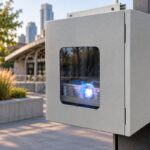
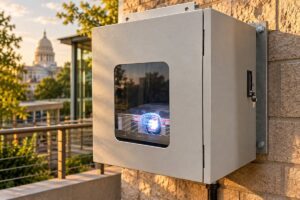
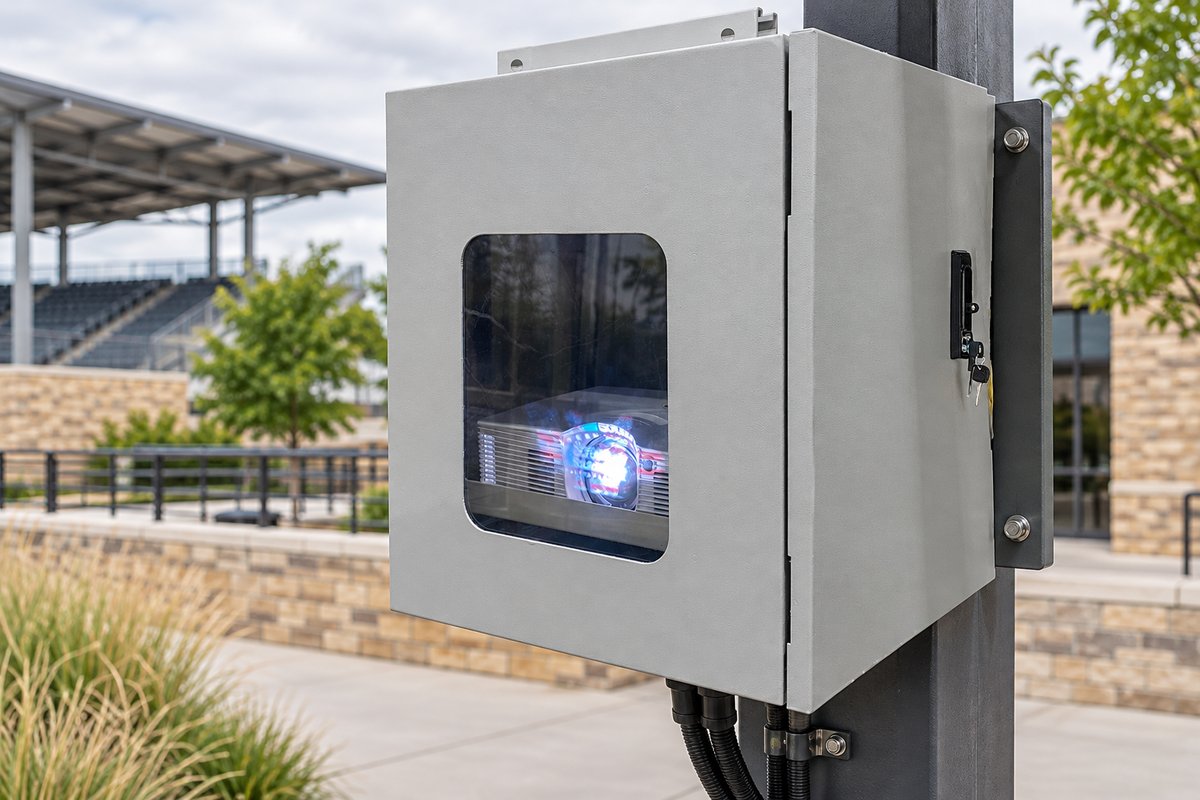
When installing an outdoor projector for mapping, look for enclosures designed to keep dust, water, and debris out—even during wind-driven downpours. Both the Defender Series Projector Enclosure and UST Defender Series Enclosure from ProjectorEnclosure.com provide IP66-equivalent protection against dust and powerful water jets. For temporary holiday or home displays, the HomeLine Projector Enclosure also shields your projector from weather swings typical of a Wichita winter.
The Impact of Heat, Humidity, Dust, and Salt Air on Projector Performance
Local projector mapping setups in Wichita need to deal with big temperature swings and high humidity that can condense inside equipment, as well as fine dust from Kansas winds. Even if you’re miles from any saltwater, salt residue and other airborne particulates accumulate over time, especially near heavily trafficked roads. These factors aren’t just nuisances—they can shorten projector life, reduce brightness, and cause costly breakdowns right in the middle of your show.
- Heat: Summer evenings can stay warm even after sundown, raising the temperature inside an enclosure. Avoid overheating by using an enclosure with active ventilation sized for your projector’s actual wattage.
- Humidity: Intruding moisture can fog lenses and cause internal corrosion. Enclosures that block rain, resist condensation, and avoid internal drips are crucial for outdoor events.
- Dust & Debris: Blowing dust can clog fans and coat projector optics. IP66-equivalent enclosures provide reliable dust exclusion—even during local dust storm advisories.
For year-round and heavy-duty projector mapping in open weather, the Defender Series is built to address all Wichita’s environmental hazards—helping keep light shows running, even as local weather shifts rapidly.
Choosing the Right Projection Mapping Projector Enclosure
Selecting the best enclosure involves more than just checking if a box is weatherproof. Sizing is key: you must match both the cooling capacity of the enclosure and the physical size of your projector. The Defender Series Projector Enclosure is available in five sizes (Small 500 W, Medium 1,500 W, Large 2,500 W, Large Plus 3,500 W, Extra Large 4,500 W)—each designed to cool projectors matching or below that wattage. Step one is to check your projector’s power draw; step two is to confirm it fits physically inside the selected enclosure.
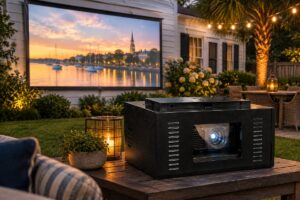
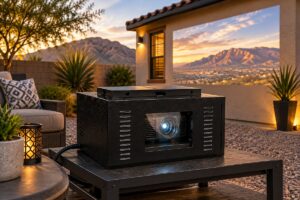
For short-throw mapping setups close to walls or in tight spaces, the UST Defender Series Enclosure is engineered for ultra-short-throw optics. This makes it perfect for Halloween or holiday house projections where space is limited and near-wall placement is essential. For home displays and occasional holiday events, the HomeLine Projector Enclosure offers practical weather protection for consumer models without the added weight of industrial systems.
Have your projector’s model ready when consulting ProjectorEnclosure.com for a recommendation, or use the step-by-step Projector Enclosure Fit Guide to make sure the enclosure matches your mapping setup.
Power and Electrical Planning for Outdoor Projector Enclosures
Once you’ve chosen an enclosure, its power and ventilation needs should be planned with as much care as the projector itself. Many projectors and enclosures have specific power draw requirements and require weather-protected outlets with ground-fault (GFCI) protection for safety. Extension cords rated for outdoor use may suffice for temporary holiday setups, but permanent installations should have dedicated outdoor-rated circuits run by a licensed electrician.
The cooling systems and fans in the Defender Series—and in all active enclosures—need a reliable, uninterrupted power source. In Wichita’s stormy weather, consider surge protection to guard against local lightning and utility interruptions. Carefully route power cabling above standing water and away from tripping hazards, and use conduit for wires exposed to the elements or landscaping equipment.
Before finalizing, double-check the National Weather Service Wichita Forecast to schedule installs around the least risky weather windows. For consistent performances, plan for a power check before each event night to ensure all equipment is working as intended.
Mounting, Airflow, and Ventilation Strategies for Longevity
Safe, stable mounting is as important as weatherproofing in projection mapping. Use sturdy brackets designed for the combined weight of your projector and enclosure, with mounting points that resist local wind gusts (especially important in open areas or on rooftops). Whether you’re projecting onto a house or a church facade, avoid positioning enclosures near sources of water runoff or direct sprinkler spray.
Ventilation is a core design feature of every Defender Series enclosure. Each size is specified by cooling wattage to ensure ample airflow for the projector inside. Never block intake or exhaust openings, and allow at least several inches of space around the enclosure—especially if grouping multiple units. For home holiday displays, the HomeLine enclosure manages airflow for sensitive consumer projectors, while still giving excellent weather protection.
Whenever possible, shelter enclosures from direct midday sun, which can significantly raise internal temperatures, and orient exhaust vents away from obstacles to maximize ventilation efficiency. Consider a short test run before the big event to monitor enclosure and projector temperatures in real-world conditions.
Understanding Local Permitting and Neighborhood Guidelines
For residential displays, temporary holiday projections generally fall under municipal nuisance and light ordinances. Commercial projections (e.g., permanent building facade shows or storefront mapping) may trigger additional requirements for equipment enclosures, electrical safety, and signage. Always check with the relevant city or county office before installing a permanent system.
Permitting processes vary depending on installation type, duration, and visibility. Some neighborhoods or historic districts may regulate outdoor attachments or restrict the use of exterior lighting. If you’re in a managed subdivision or business district, consult the appropriate office linked above.
For event setups, safety should extend beyond local code—ensure that projector and enclosure placement never blocks exits, public paths, or access to utilities. Use the most conservative guidelines when planning setup heights and distances from property lines or walkways.
Enclosure Selection: Practical Examples for Wichita’s Most Popular Uses
Every mapping project is unique, but matching your enclosure to your actual application is the best way to ensure performance. For projecting onto houses or garage doors during major holidays, the dedicated Projector Enclosure for House Projection Mapping is designed with homeowners in mind, offering practical mounting and access features.
Building-facade projection mapping for schools, churches, or businesses is best managed with the Defender Series, whose size options provide flexibility for everything from compact models to high-power projectors. Short-throw and close-range mapping—such as window and doorway projections—are tailored for the UST Defender Series. Each model features weather protection and active cooling needed to keep shows running through fluctuating Kansas weather.
For all enclosures, every unit from ProjectorEnclosure.com is backed by a 1-year warranty. Their experience—more than 20 years in business—helps customers select the best protection for any setup or budget.
FAQ: Outdoor Projector Mapping for Wichita’s Climate
How do I know what size enclosure I need for my projector?
Start by identifying your projector’s power draw (in watts), then match it to one of the five Defender Series enclosure sizes, or to the HomeLine for home use. After selecting by wattage, always check your projector’s physical dimensions against the enclosure, or use the Projector Enclosure Fit Guide, and have your projector model handy for an exact fit check.
Can I leave my projector enclosure outside year-round in Wichita?
The Defender Series and UST Defender Series enclosures offer IP66-equivalent protection against Wichita’s rain, humidity, and dust—making them well-suited for year-round use. For permanent setups or continuous operation, periodic inspection and cleaning is recommended to preserve airflow and enclosure seals.
Do I need a building permit for a house projection show?
Most temporary home holiday projections do not require a building permit, but larger or permanent outdoor installations—especially for commercial sites—may have local code, permit, or neighborhood restrictions. For current requirements, check with your city or neighborhood association office before installation.
Start Planning Your Wichita Projection Mapping Show
The right projector enclosure keeps your creative vision safe from Kansas weather, while minimizing hassles with power, mounting, and regulations. Whether your setup is for adding sparkle to a family home, animating a school wall, or lighting up an entire downtown block, careful planning and an enclosure suited to both your projector and local conditions are critical. For hands-on support and enclosure sizing, Request an enclosure quote today and get started with expert guidance and proven all-weather solutions from ProjectorEnclosure.com.
- National Weather Service Wichita Forecast – For checking current heat, humidity, rainfall, and weather impacts on outdoor setup
- Projector Enclosure Fit Guide – Step-by-step sizing for your specific projector model
Supplies mentioned in this guide
Defender Series Projector Enclosure
UST Defender Series Enclosure
HomeLine Projector Enclosure
Projector Enclosure for House Projection Mapping
Projector Enclosure Fit Guide
Real-World Uses for Projection Mapping Projector Enclosures in Lakeland, FL