
A Practical Guide to Outdoor Projector Enclosures in Chiefland, FL
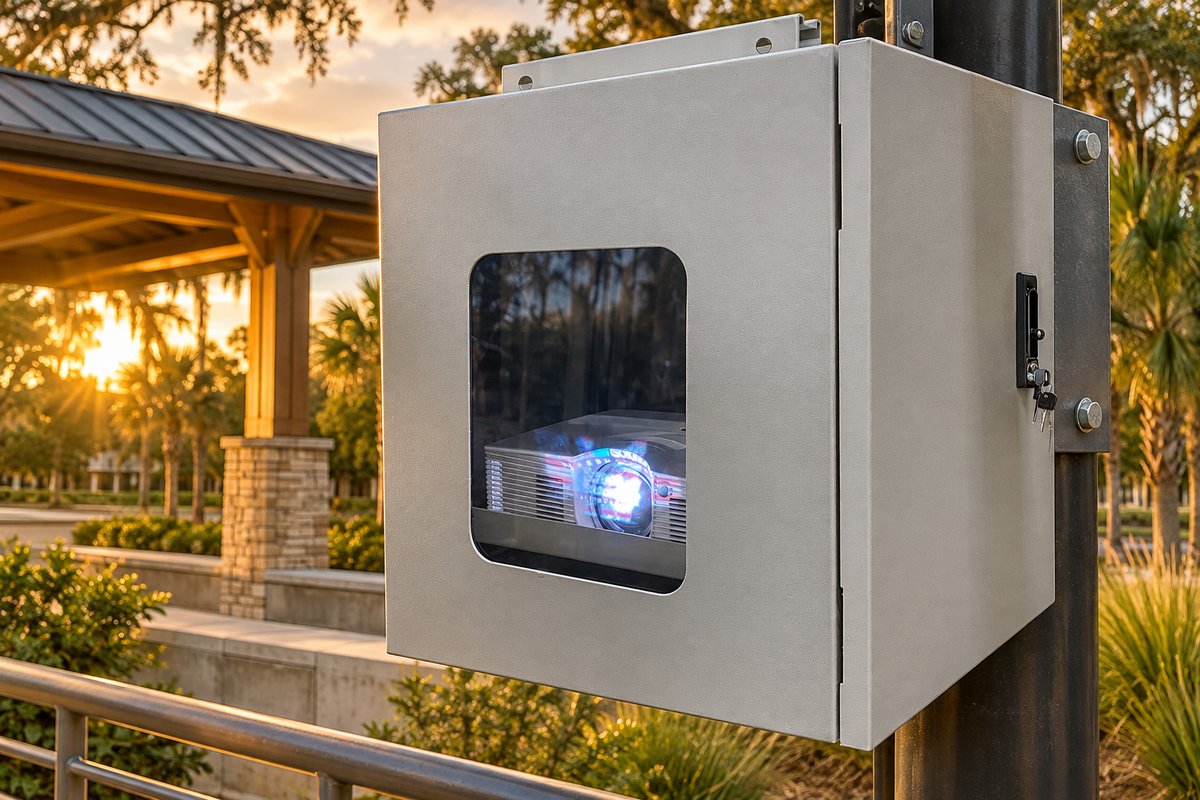
A Practical Guide to Outdoor Projector Enclosures in Chiefland, FL
Explore expert strategies for protecting outdoor projectors in Chiefland, FL. This guide covers local heat, storms, and planning for power, mounting, ventilation, and permits.
Understanding the Chiefland, FL Environment for Outdoor Projection
When planning an outdoor projector installation in Chiefland, Florida, it’s important to consider the city’s distinct weather patterns and environmental factors. Chiefland is known for its humid subtropical climate—a combination that can be tough on electronic equipment exposed outdoors year-round. Local summers regularly bring daytime highs into the mid-90s with high humidity, while sudden, heavy rain showers and frequent thunderstorms are common during the rainy season.
Long-range projectors are often used at sports fields, amphitheaters, drive-in events, schools, parks, and in outdoor pavilions at churches or resorts. For these high-value installs, understanding how heat, humidity, and heavy rain can affect your projector and its electronics is crucial. Even if your space seems shaded or out of direct weather, humidity and pervasive dust can still impact reliability. Reviewing the current Chiefland weather data is a smart first step when planning your project.
For venues that depend on consistent projection—from summer movies in the park to school events—investing in an enclosure designed for open weather can protect your investment and ensure worry-free operation, rain or shine.
Local Weather Hazards: Heat, Humidity, Rain, and Dust
Extreme heat, intense sunlight, humidity, and airborne dust make Chiefland a challenging location for outdoor electronics. Projector bulbs and electronics generate significant internal heat, especially when running for hours, and the added solar load from the Florida sun only increases this burden. It’s not unusual in summer for ambient temperatures to remain above 80°F even after the sun drops—a fact every AV integrator should consider.
Moisture is a year-round concern. Chiefland’s high humidity levels (often above 85% in summer) can cause internal condensation in inadequately protected enclosures, potentially damaging sensitive optics and electronics. Sudden downpours—common from June through September—demand that outdoor projector enclosures be fully rain resistant, not just weather-resistant in name. Dust is a subtler threat: pollen counts are high for much of the year, and unsealed enclosures can accumulate dust that settles onto lenses and cooling fans, degrading image quality and performance.
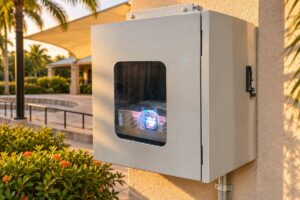
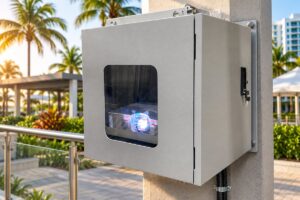
In this setting, an IP66-equivalent Defender Series projector enclosure is designed to meet the demands of open weather, shielding equipment against powerful water jets, dust, and debris—and crucially, managing internal climate conditions through active ventilation and cooling.
Why a Climate Controlled Projector Enclosure Is Essential
Many outdoor venues and installation teams underestimate the impact of environmental stress on projectors. Direct exposure to heat or uncontrolled temperature swings can sharply reduce projector lifespan and create unreliable performance at community events, outdoor attractions, or church gatherings. Humidity and rain can cause corrosion or outright failure, especially if the enclosure is not actively ventilated and climate controlled.
The Defender Series climate controlled projector enclosure is built for these open-weather challenges. Unlike simple vented boxes or covers, the Defender Series features advanced climate controls designed to stabilize internal temperatures and prevent moisture buildup—making it an ideal choice for hot, humid Chiefland evenings and unpredictable summer storms. Internal performance is matched to the actual power draw of your projector, so each unit is sized for effective cooling and long equipment life.
Choosing a properly sized, climate controlled projector enclosure isn’t just a matter of convenience—it directly impacts projector reliability, event continuity, and overall cost of ownership for schools, theme parks, or private homeowners hosting outdoor movie nights.
Power Planning and Safe Connectivity
Outdoor projector installs demand careful planning for power supply, safety, and cable runs. In Chiefland, sudden thunderstorms can send power surges through lines, so all outdoor-connected electronics—especially projectors—should incorporate surge protection and weatherproof outlets. It’s important to assess available circuits, expected load from the projector and enclosure fans, and the distance from the nearest power source before finalizing your site plan.
Before running extension cords outdoors, check current weather conditions using Chiefland weather resources and ensure all cabling is rated for exterior use. Wireless connections may be attractive, but be aware that humidity and rain can impact wireless reliability. Low-voltage cable for control or video lines should be kept out of constant wet ground contact.
Power demands for the Defender Series Projector Enclosure depend on both the enclosure cooling size and the projector’s own draw. ProjectorEnclosure.com matches your setup to the right enclosure size and provides guidance on safe, code-compliant connections. For help, send your projector make and model along with project site details for review.
Mounting and Site Selection in Chiefland
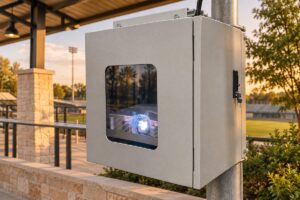
Chiefland projectors are frequently installed on light poles at athletic fields, under pavilion roofs at resort pools, or on church grounds for outdoor services. Your mounting options will vary depending on the installation site, but in all cases, a strong, vibration-resistant platform is essential for long-term outdoor use.
The Defender Series enclosures ship with multiple mounting possibilities—ceiling, wall, and pole configurations can all be supported with proper hardware. Site choice should take into account prevailing winds, as gusts from summer storms can stress mounts and cables. Whenever possible, locate enclosures where falling branches, water runoff, or accidental bumps can be avoided.
For installations exposed to weather on all sides, consider wind protection and ensure that mounting hardware is properly anchored in concrete or structural framing. Review the recommended enclosure site guidelines with ProjectorEnclosure.com staff—providing your projector’s dimensions and the specifics of your mounting location ensures your system is matched to both the projector and the site.
Ventilation, Airflow, and Protection from Elements
Humidity and heat don’t just threaten projectors—they can also trap hot air inside an enclosure, even with a weather-sealed box. That’s why active ventilation and climate control sets the Defender Series apart. Each enclosure size (Small through Extra Large) is matched to a cooling wattage and internal airflow rating to keep the inside environment safe for your projector. This protects against both heat buildup and internal fogging/condensation caused by rapid temperature shifts after rains or during humid, hot nights.
Properly sized ventilation depends not just on the projector’s wattage but also its footprint—so ProjectorEnclosure.com recommends providing both your model and size, allowing the team to select the best enclosure for your needs. If your requirements fall outside the five standard sizes, custom enclosures are available—just call or request a quote for guidance.
Remember: an enclosure with “open” vents (not rated for dust and water) is not suitable for Chiefland’s weather. The Defender Series and UST Defender Series Enclosure offer IP66-equivalent protection against dust and powerful water jets, ensuring peace of mind through summer storms and year-round outdoor use.
Permits, Local Codes, and Planning for Long-Term Safety
Any permanent electrical or AV installation outdoors in Chiefland may require site-specific permits and must comply with local codes. For most venues, especially public or commercial spaces like schools, resorts, and churches, this is not just best practice—it’s required. Permitting can cover electrical work, structural mounting, and sometimes light pollution or projection on public property.
Start by consulting with Chiefland’s building department or your venue’s facilities manager when you begin outdoor projection planning. Code requirements can shift, especially in communities affected by extreme weather. Use the Chiefland weather forecast as documentation for site risk assessment during the permitting phase. For specific permit application steps, check with the office linked above based on your exact project details.
The experienced ProjectorEnclosure.com team is available every step of the way—they can recommend best practices for code compliance and mounting but always recommend official review for every install. If unsure, contact the city or your AV consultant before finalizing plans.
How to Specify the Right Defender Series Enclosure
Proper enclosure sizing is a two-step process, and every environment—including Chiefland’s—makes careful selection essential. ProjectorEnclosure.com offers the Defender Series in Small (500 W), Medium (1,500 W), Large (2,500 W), Large Plus (3,500 W), and Extra Large (4,500 W) cooling sizes. Each is built for projectors whose power draw is at or below the enclosure’s cooling wattage.
Step one: match your projector’s wattage to the appropriate enclosure size. Step two: confirm that your projector’s physical dimensions fit inside. If the projector is oversized or unusually shaped, custom enclosures built for your projector and site are available—call 888-631-5880 or request a quote for details.
To get started, use the Projector Enclosure Fit Guide, and send your projector’s make and model. The ProjectorEnclosure.com team will confirm the right options and best practices for long-term reliability at your Chiefland site.
FAQ: Outdoor Projector Enclosures in Chiefland, FL
What if my projector is a unique size or very powerful?
ProjectorEnclosure.com matches each projector to the right standard Defender Series size by both power draw and physical size. Most models fit in one of five standard sizes, but if your projector is especially large or requires special mounting, custom enclosures are available to meet your needs—just reach out for guidance.
Do I really need climate control for my outdoor enclosure in Chiefland?
Yes. Chiefland’s heat and humidity can damage sensitive projector components and optics. A climate controlled projector enclosure such as the Defender Series is designed to manage both temperature and moisture, reducing risk of failure and maintenance issues in open-weather sites.
How do I ensure my installation meets code?
Check with your local permitting office, especially for permanent outdoor power or structure mounting. Codes can change depending on property use (public, commercial, private) and environmental risks. The ProjectorEnclosure.com team can help ensure your order fits the intended site and recommends all local permitting be confirmed before installation.
Resources and Getting Started
- Check current Chiefland, FL weather data for planning.
- Review the Defender Series Projector Enclosure for climate controlled, all-weather installs.
- Download the Projector Enclosure Fit Guide to start the sizing process.
- Explore the UST Defender Series Enclosure for ultra-short throw projectors.
Ready to protect your investment and ensure reliable outdoor projection in Chiefland, FL? Request an enclosure quote and let ProjectorEnclosure.com match your projector to the right climate controlled outdoor projector enclosure for your environment.
Supplies mentioned in this guide
Defender Series Projector Enclosure
UST Defender Series Enclosure
Projector Enclosure Fit Guide
A Practical Guide to Outdoor Projector Enclosures in Palestine, TX