
Practical Guide: Outdoor Projector Enclosures for Lake Charles Climate

PROJECTORENCLOSURE.COM
Lake Charles, LA · Planning guide

Practical Guide: Outdoor Projector Enclosures for Lake Charles Climate

Lake Charles’ heat, storms, humidity, and salt air can challenge any outdoor projector setup. Learn local best practices for all-weather projector housing, power, mounting, ventilation, and permits.

Understanding Lake Charles Climate and Its Impact on Outdoor Projectors

Lake Charles, LA, presents a unique climate for anyone planning an outdoor projection system. With summer temperatures frequently soaring and direct sunlight often striking exterior surfaces, managing heat is essential for electronics longevity. Add to this the region’s persistent humidity, routine rainfall, dust kicked up by coastal breezes, and the presence of salt air near the Calcasieu estuary — and outdoor AV equipment faces a gauntlet of hazards.

These environmental factors accelerate projector wear, can short-circuit sensitive components, and even cause image distortion. Humidity and salt foster corrosion, while dust and debris infiltrate projector vents, clogging cooling fans. Rain and severe storm events, especially during hurricane season, increase the risk of acute damage. By understanding these forces, you can plan an installation that minimizes downtime and onsite emergencies.

Whether you’re a local AV integrator, property manager, or homeowner, planning for Lake Charles’ distinctive weather is the foundation of a reliable and long-lasting outdoor projector setup. Tailoring your installation to these realities matters as much as choosing the projector itself.

The Critical Role of a Weatherproof Projector Housing

Given the environmental pressures in Lake Charles, a purpose-built outdoor projector enclosure is essential to safeguard your investment. Traditional AV cabinets or generic housings usually fail when faced with intense sun, high humidity, and driving rain. That’s where climate controlled projector enclosure technology from ProjectorEnclosure.com comes into play.

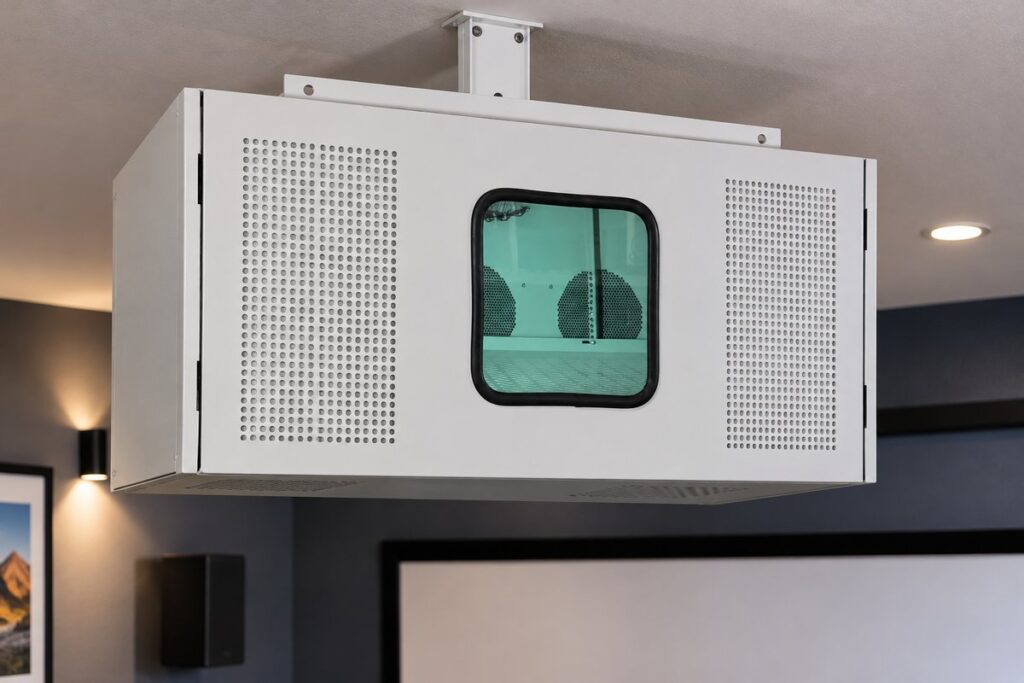
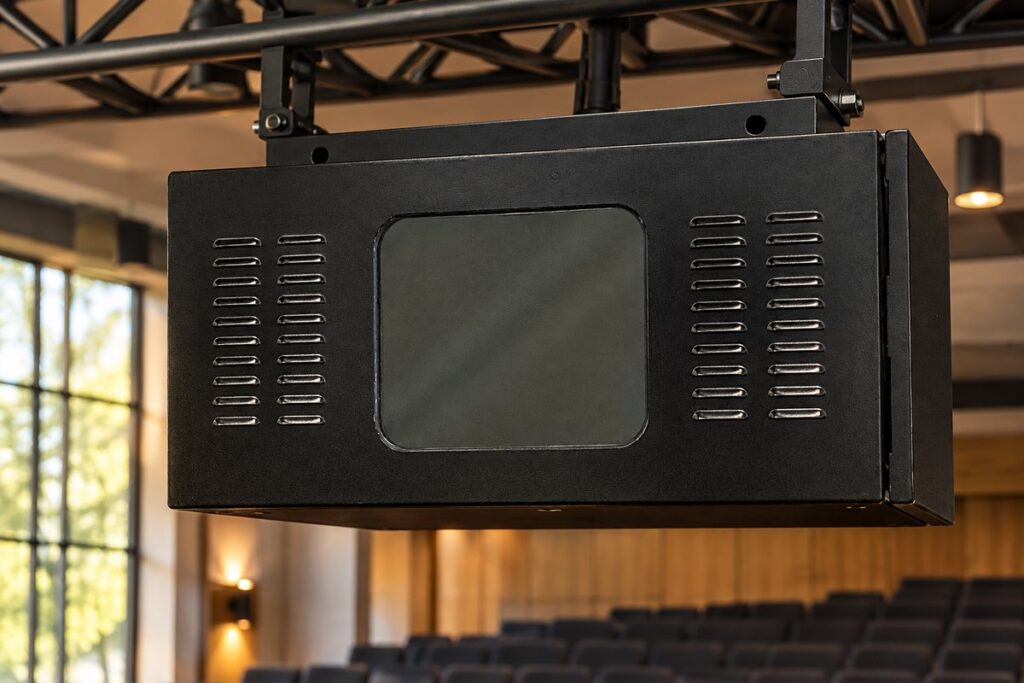
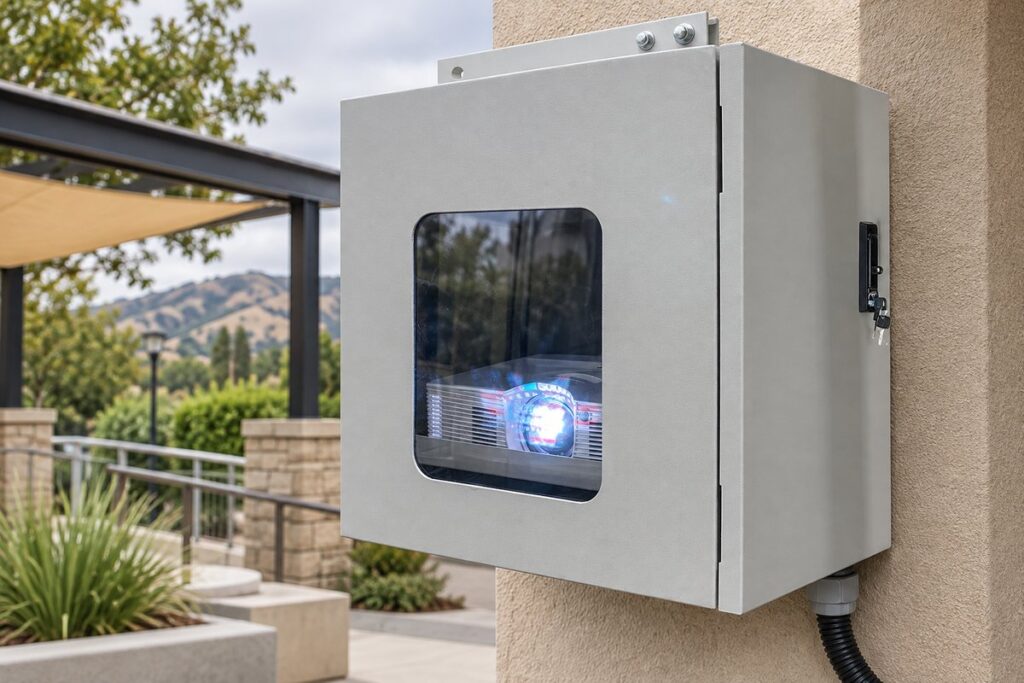
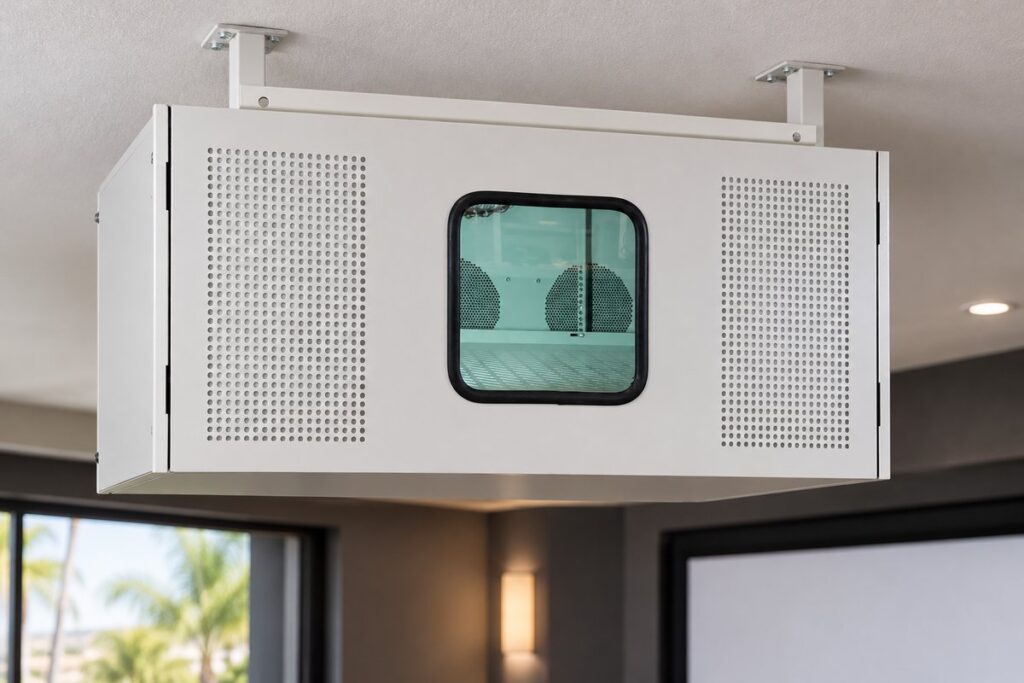
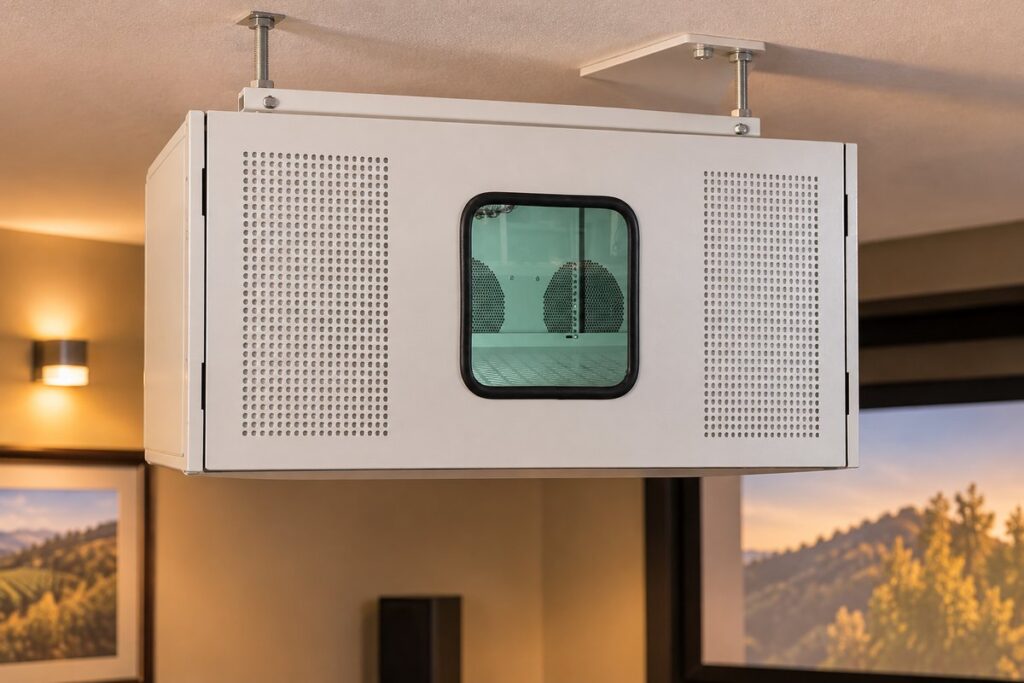
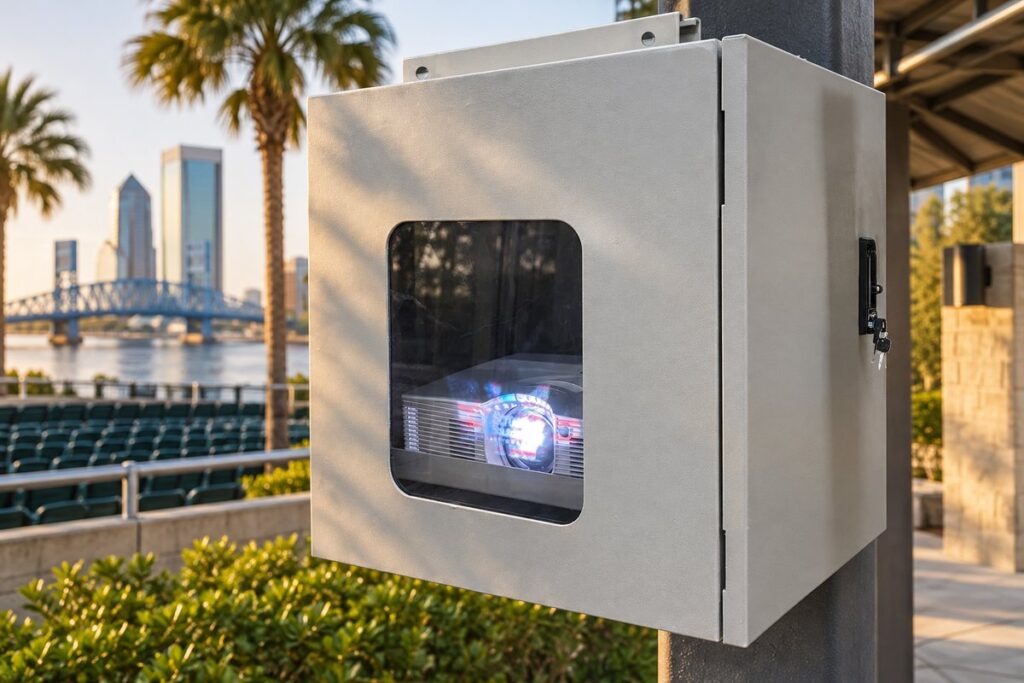
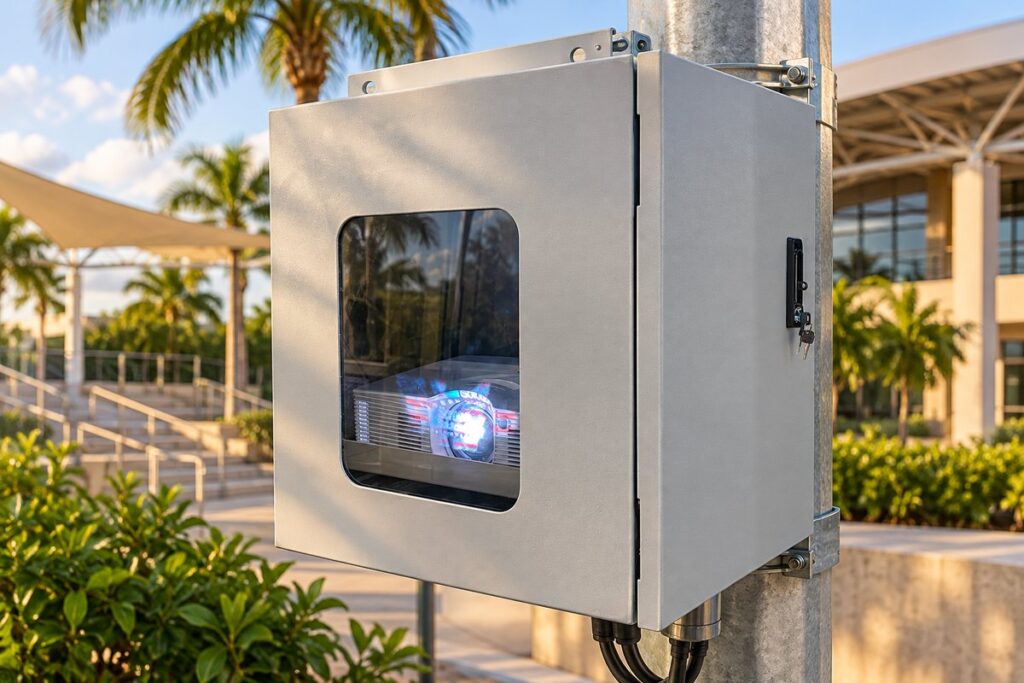
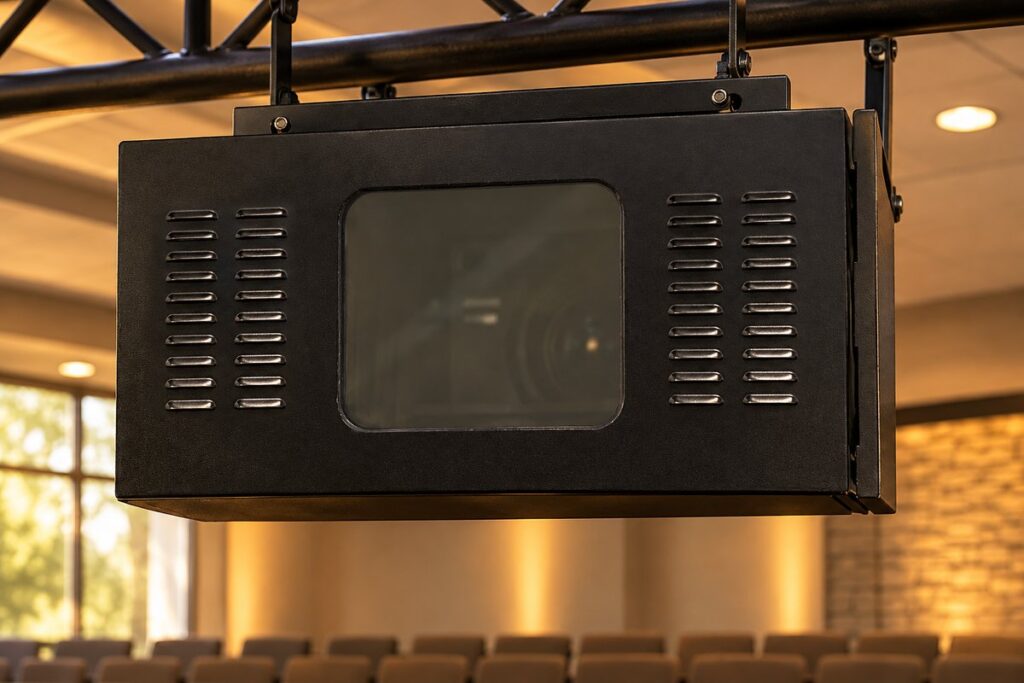
The Defender Series Projector Enclosure is engineered specifically for outdoor and all-weather use. With features designed to combat direct sun, humidity, frequent rainfall, salt spray, and flying debris, the enclosure maintains a stable microclimate for your projector. Internal electronics remain shielded from the elements, while adjustable fan-cooling units control internal temperature and humidity. For ultra-short throw models, the UST Defender Series Enclosure offers specialized protection.

This weatherproof projector housing approach ensures AV integrators, schools, resorts, and even homeowners can achieve year-round outdoor projection without constant troubleshooting or repairs. Always provide your specific projector make and model so the enclosure can be sized for optimal airflow and protection.

Managing Heat, Ventilation, and Direct Sunlight

Summer heat and unyielding sunlight are among the greatest challenges in Lake Charles. When the sun beats directly on an enclosure’s surface, internal temperatures can surge, risking component failure. The right climate controlled projector enclosure incorporates fan-cooling or conditioning elements that actively manage internal temperatures, ventilate hot air, and resist heat buildup—even in peak afternoon swelter.

Careful placement of your enclosure helps, too. Whenever possible, locate the enclosure in a shaded area or provide a rain-and-sun shield over the installation. This reduces direct solar exposure and prolongs the life of both projector and enclosure components. For permanent setups, include sun studies or consult a local architect if available.

Ventilation is just as important as temperature control. Dust and pollen are frequent in Lake Charles, especially during dry or windy spells. The Defender Series features filtered, directional airflow to keep airborne particles out while cooling electronics. Always check that intake and exhaust routes won’t recirculate hot or dusty air from nearby HVAC outlets or ground sources.

Combating Humidity, Salt Air, and Corrosion

Humidity in Lake Charles regularly hovers well above the national average. This, coupled with airborne salt closer to the coastline, makes corrosion one of the chief hazards for anything with metal parts or sensitive electronics. Over time, even “sealed” projector housings may allow entry of moisture or fine salt crystals, accelerating rust and electrical failures.

Climate controlled projector enclosures from ProjectorEnclosure.com are designed to resist ingress and efficiently vent internal moisture. For added assurance near the lake or marshes, locating your enclosure upwind of salt spray and several feet above grade can also help. Inspect and wipe down exterior surfaces routinely, particularly following major storms or high-humidity weeks.

Ensure all cable entry points into the enclosure are secured and sealed according to product guidelines; this minimizes points where moist air and salt might sneak in. Ask about recommended service intervals based on your exact location for additional corrosion management tips.

Planning for Power and Outage Management

Reliable outdoor projector performance relies on stable, secure power. Lake Charles is no stranger to weather-related outages and surges — particularly during heavy rains and storms. Before you install an outdoor projector enclosure, verify circuit capacity and consult with a licensed electrician for suitable weather-rated conduit and ground fault protection.

For venues or schools, consider a dedicated circuit to avoid nuisance tripping or overloading shared lines. Surge protectors and power conditioners provide a further layer of protection against storm-related voltage spikes. For any critical installation, monitoring real-time grid status using the Entergy Outage Map can help with contingency planning, such as an automatic shutdown protocol for sensitive equipment.

Be sure all exterior outlets and wiring enclosures meet local code for outdoor use. For cable runs between buildings and enclosures, weatherproof rated fittings are a must. A backup plan for major events, such as generator or battery backup, should be considered during hurricane season or for high-importance events.

Mounting Best Practices and Secure Installation

Once you lock in enclosure sizing, mounting becomes the next crucial step. With Lake Charles’ periodic storms and high winds, outdoor projector enclosures must be securely anchored to resist both lateral and upward wind forces. Consider partnering with an experienced integrator or general contractor familiar with local wind engineering requirements for outdoor AV structures.

Wall mounts, ceiling hardware, and pole-mount kits must be rated for the weight of the fully loaded enclosure and account for vibration or possible impact from debris. ProjectorEnclosure.com systems can support a range of mounting options, which should be matched to your site and anticipated weather loads.

Allow for at least several inches of clearance on all sides of the enclosure for airflow and future maintenance. Never block ventilation grills or filters. Review every anchor point after major storms, especially during hurricane season, for signs of shifting, water intrusion, or hardware loosening.

Local Permitting, Codes, and Safety Regulations

Permitting requirements in Lake Charles for permanent outdoor electronics can be complex, depending on your property type and installation height. Before beginning installation, check with the local code office for rules around exterior AV devices, including structure-mounted and freestanding projector enclosures. Requirements for electrical supply, wind anchorage, and weatherproofing can vary.

Engage any necessary project stakeholders — from general contractors to IT staff for data runs — during the planning stage. For schools, venues, or faith organizations, integrating with existing emergency management and facility maintenance procedures is recommended.

Permit review may require engineered plans for large or permanent structures, especially near the lakeshore or within storm zone overlays. Check with the office linked above for the latest protocols so your projector system remains compliant and insurable.

Choosing and Sizing the Right Projector Enclosure

The centerpiece of a reliable system is a properly sized enclosure tailored for your specific projector model. This step ensures safe operating clearances, optimal airflow, and seamless fit for mounting and maintenance access. The quickest way to size your enclosure is to use the Projector Enclosure Fit Guide and provide ProjectorEnclosure.com with your projector’s make and model.

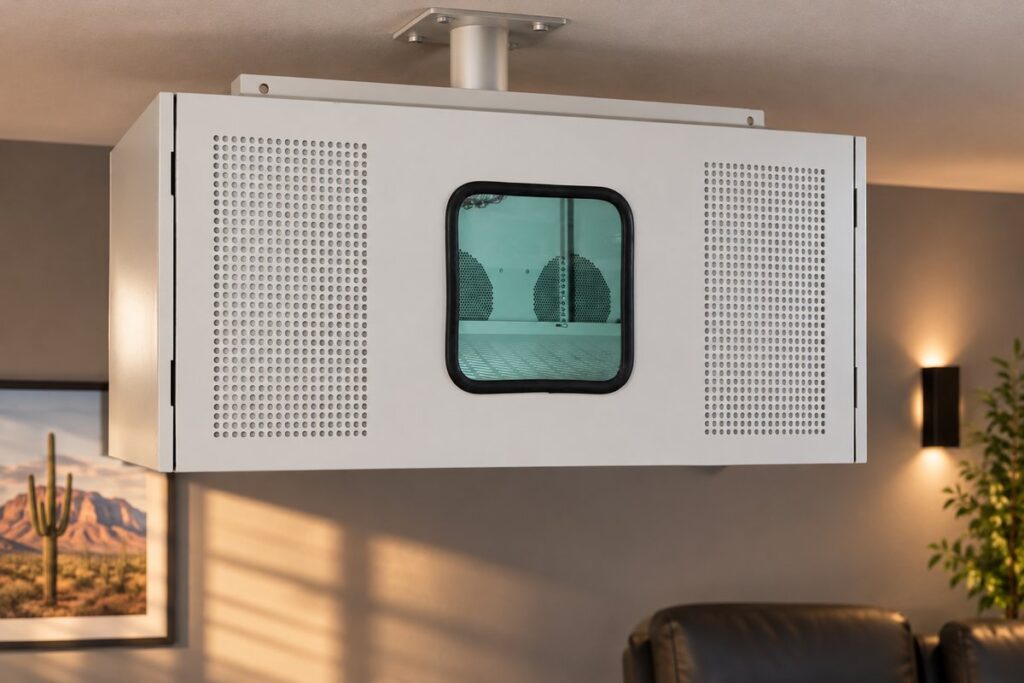
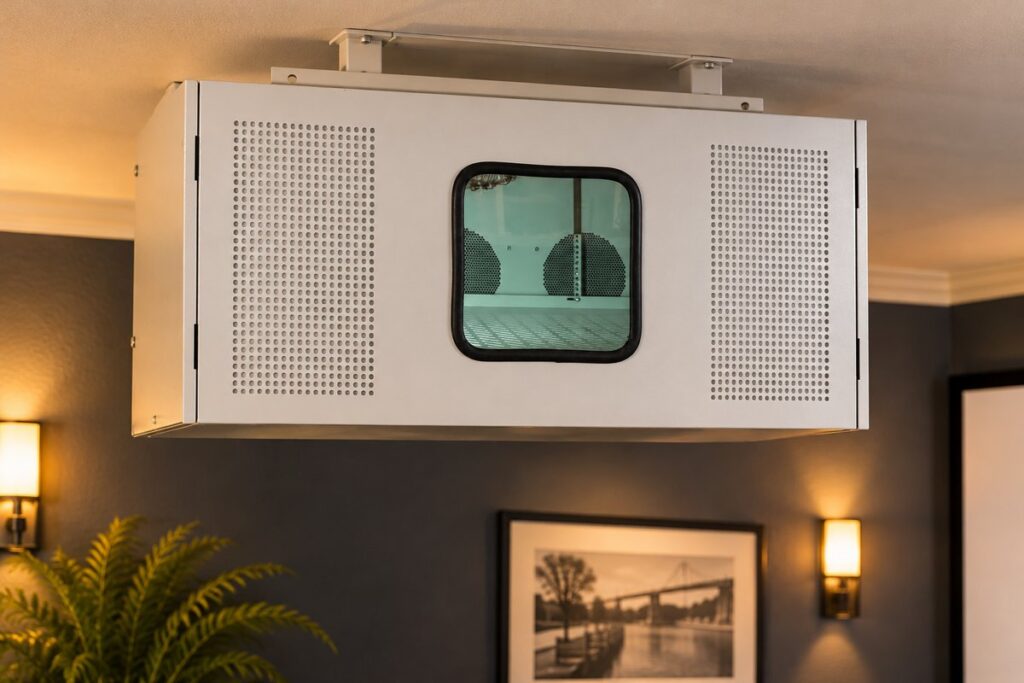
For general outdoor and all-weather protection, the Defender Series is the solution of choice. If your installation is in a covered or indoor but air-conditioned outdoor space, the Integrator Series is ideal for climate-controlled locations not exposed to direct weather. Residential and consumer projection mapping projects can take advantage of the HomeLine Projector Enclosure.

Remember: the Hush Series is for indoor (quiet room) settings and not suitable for outdoor or exposed use. If planning an ultra-short throw display outdoors, specify the UST Defender Series Enclosure. Each model is built to the same principles — reliable, long-lasting protection suited to the climate and application.

FAQ: Outdoor Projector Enclosures for Lake Charles

How often should I inspect my outdoor projector enclosure?

During peak heat, humidity, or just after storm events, check your outdoor enclosure for water or dust intrusion, corrosion on latches or connectors, and that all ventilation grills are clear. Monthly inspections and post-storm checks will help catch minor issues before they become major problems in Lake Charles’ variable weather.

What’s the best way to protect against storm-related power outages?

Work with your electrician to install surge protectors and battery backup for critical installs. Check the Entergy Outage Map regularly during storm season to anticipate and respond to power interruptions that could affect your projector system.

Can I use any enclosure outdoors, or do I need a specific model?

Not all enclosures can withstand Lake Charles’ climate. For true outdoor and all-weather use, only the Defender Series and UST Defender Series are suitable. Never use indoor-only models, like the Hush Series, in exposed locations.

Need help selecting the right weatherproof projector housing for your AV project? Request an enclosure quote from ProjectorEnclosure.com, or call 888-631-5880 / email ssisales@ssidisplays.com with your projector make and model for expert advice.

Featured supplies

Supplies mentioned in this guide

PROJECTORENCLOSURE.COM · Lake Charles, LA guide
Read more

Outdoor Projector Enclosures in Palmdale: A Climate-Smart Planning Guide

PROJECTORENCLOSURE.COM
Palmdale, CA · Planning guide

Outdoor Projector Enclosures in Palmdale: A Climate-Smart Planning Guide

Palmdale’s extreme weather deserves careful planning for your outdoor projector enclosure. Discover how to protect your projector against summer heat, humidity, dust, and more, and how to design your AV setup for success.

Palmdale’s Climate: The Outdoor Projector Enclosure Challenge

Palmdale, CA, sits at the heart of the Antelope Valley. Known for its powerful summer sun, dry heat, unexpected dust storms, and occasional rains, this region demands careful planning for any outdoor technology installation. Projectors used in AV displays for schools, places of worship, theme parks, resorts, or even backyard entertainment are at risk from high temperatures, blown dust, and sudden shifts in humidity. In some areas closer to the coast, your setup may even contend with salt air, which can corrode sensitive components if left unprotected.

It’s important to consult detailed forecasts like the NWS Extended Forecast for Palmdale CA before installing any outdoor projector equipment. Conditions can shift quickly—from triple-digit afternoons to chilly evenings—affecting temperature inside the enclosure. Dust in the Antelope Valley is more than a nuisance; it can impair ventilation and optics, while rare heavy rains call for robust weatherproof projector housing solutions that are purpose-designed for outdoor environments.

The solution is a climate controlled projector enclosure specifically sized and engineered for your location and equipment. Local operators, from AV integrators to homeowners, can avoid costly repairs or replacements by understanding these environmental pressures and choosing the right protective housing from the start.

Choosing the Best Enclosure: Palmdale Applications

Not all projector enclosures are suitable for outdoor use. For Palmdale’s climate, it’s critical to select an enclosure that stands up to temperature swings, UV exposure, and the physical realities of outdoor placement. ProjectorEnclosure.com’s Defender Series Projector Enclosure is engineered as an all-weather option ideal for desert heat and dust, protecting the projector from the elements while maintaining cooling airflow.

Applications such as school events, church services, resort drive-in nights, or theme park displays face direct sun and airborne grit. The Defender Series uses active fan cooling to combat internal heat buildup, critical under the Palmdale sun. Enclosures that are merely ventilated without active airflow often fail during the region’s hottest months.

If you’re mounting in a conditioned environment such as a protected pavilion or covered stadium where outdoor climate threats are controlled, consider the Integrator Series Projector Enclosure. Always match the housing to your site’s true exposure—never use the Hush Series outdoors, as it’s built for quiet indoor spaces only, or the Integrator in direct weather.

Humidity, Dust, and Salt Air: Palmdale’s Environmental Risks

While Palmdale is generally dry, seasonal humidity and nightly dew add complexity to outdoor projector setups. Moisture can sneak in through poor seals or unfiltered vents, endangering sensitive electronics. Dust is ever-present in the Antelope Valley, and it’s notorious for creeping into any gap, clogging fans, and settling on optics, reducing image quality and device longevity.

For venues near the coast, trace salt air can carry far enough inland to introduce corrosion risk on unprotected metal and electronics. Salt residue accelerates aging if left unchecked, making a sealed, fan-cooled, weatherproof projector housing like the Defender Series critical for these site conditions.

To maximize the life of your outdoor projector, always use an enclosure with active filtration and ensure it’s properly sized for your projector model. Check out the Projector Enclosure Fit Guide for help matching your projector to a compatible model. For specialty setups such as ultra-short-throw projectors used in projection mapping, explore the UST Defender Series Enclosure.

Power Planning for Your Outdoor Projector Solution

Outdoor projector installations in Palmdale draw more than just electrical current—they draw on the reliability and consistency of your site’s power delivery. The region experiences fluctuations and outages, especially during the summer when high temperatures spike antelope valley’s energy use. Before finalizing your installation, verify your service level and requirements by consulting with the local power authority. Recent updates and new programs are announced at Palmdale’s EPIC launch page, making it a valuable resource for checking infrastructure and planned upgrades that can affect AV installations.

When planning, ensure your projector enclosure has a dedicated and grounded supply, separate from lighting or irrigation circuits that may cause interference. Sudden power loss can interrupt projectors mid-use, so consider integrating surge protection or uninterruptible power supplies (UPS) for mission-critical venues such as schools and theme parks. Consult a licensed electrician familiar with outdoor and AV-specific requirements for safe, code-compliant connections.

Outdoor power planning should include easy access for maintenance and the possibility of future expansion for larger AV projects. Always size electrical feeds and junctions according to the highest possible equipment draw, not just your initial projector size, to keep upgrade options open.

Mounting and Site Selection: Sun, Wind, and Visibility

Mounting your outdoor projector enclosure isn’t as simple as picking a location with a good view of the screen. In Palmdale, sun tracking is crucial; direct sunlight on the enclosure, especially in late afternoon, can spike internal temperatures and tax cooling fans. Place your enclosure in a shaded or north-facing area if possible, or use architectural features to block the harshest rays.

Wind and dust are year-round factors. High winds—especially during seasonal storms—demand secure mounting. Choose mounting hardware rated for outdoor loads and install anchors appropriate for your site’s structural material. For installations in backyards or schools, make sure enclosures are mounted above flood level and high enough to avoid accidental impacts or vandalism.

Visibility and sightlines should complement the enclosure’s environmental protection. Plan projector throw distance carefully, as enclosures add length between lens and screen. For non-standard projection (such as mapping or ultra-short-throw), the HomeLine Projector Enclosure can be considered for residential setups, but only in locations protected from direct weather.

Ventilation and Climate Control for Long-Term Reliability

Proper ventilation is fundamental in Palmdale’s environment, where daytime highs and nightly lows can swing widely. Passive airflow is rarely adequate outdoors due to dust and temperature extremes. ProjectorEnclosure.com’s Defender Series uses a fan-cooled design to expel heat and filter out grit, supporting both projector longevity and optical clarity.

For covered spaces with temperature control, the Integrator Series is a good match, allowing for quieter operation and modest protection when weather exposure is limited but indoor dust remains a concern. The climate controlled projector enclosure approach ensures your AV investment endures season after season, without mid-summer overheating or internal corrosion due to humidity.

Maintenance counts: set a schedule to check filters, fans, and internal temperatures—especially after weather events or high-dust days. Seasonal checks, especially before the first major summer heat wave or after fall dust storms, will extend your projector’s lifespan and prevent unexpected failures during events or performances.

Permitting Your Outdoor Projector Enclosure Installation

Palmdale’s permitting requirements for outdoor AV installations depend on factors such as structure height, electrical supply, and intended use. Schools, churches, public venues, and permanent residential installations may all need permits for electrical, structural, or both. These can cover everything from surface-mounting to trenching new power or data lines.

Check with Palmdale’s local permitting office, often referenced from the city newsflash page. Because regulations, electrical codes, and engineering reviews can change, it’s always wise to speak with the office early in your planning process. Required drawings or specifications may depend on enclosure size, power draw, or proximity to pedestrian walkways.

Professional AV integrators and venue operators are encouraged to work with licensed contractors who understand local codes. This ensures safer, faster project completion and helps prevent costly corrections after inspection. Never begin installation or trenching before obtaining clear guidance and approvals. Requirements can apply to both commercial properties and homes depending on the installation specifics.

FAQs: Outdoor Projector Enclosures in Palmdale

What size enclosure do I need for my projector?

Enclosure sizing depends on your specific projector model, cooling requirements, and installation site. Use the Projector Enclosure Fit Guide or send your projector details to ProjectorEnclosure.com’s team to ensure a perfect fit for both ventilation and access.

How do I prevent dust and heat from damaging my projector?

Choose a weatherproof, fan-cooled enclosure like the Defender Series for maximum protection. Regularly monitor filters and airflow, especially after dust storms or during extreme heat. Palmdale’s combination of sun and dust makes these measures essential for reliability.

Are permits required for all outdoor projector installs?

Permitting depends on your location, property type, and the installation’s permanence. Commercial and public venues almost always need permits, while some residential projects might not. Check with local authorities—guidance is available on Palmdale’s official newsflash page.

Conclusion: Protecting Your Outdoor AV Investment

Palmdale’s climate creates exciting opportunities—and real environmental risks—for projection displays. The right outdoor projector enclosure keeps your AV equipment running bright and sharp through summer sun, desert dust, or the occasional soaking rain. ProjectorEnclosure.com offers more than 20 years’ experience in tailoring enclosure solutions for tough climates like Palmdale’s, with size and ventilation options for every application—just send your projector model for fast recommendations.

To get expert advice and a solution sized for your outdoor projector, Request an enclosure quote from the specialists at ProjectorEnclosure.com today.

Featured supplies

Supplies mentioned in this guide

PROJECTORENCLOSURE.COM · Palmdale, CA guide
Read more

Planning Outdoor Projector Enclosures in Redding: A Practical Guide

PROJECTORENCLOSURE.COM
Redding, CA · Planning guide

Planning Outdoor Projector Enclosures in Redding: A Practical Guide

Learn how Redding’s climate impacts outdoor projector installations. Explore ventilation, power, mounting tips, and find weatherproof projector housing solutions tailored for your projector model.

Redding’s Outdoor Projector Challenge: Heat, Sun, Dust & More

Installing a projector outdoors in Redding, CA, comes with unique climate challenges. With summer highs frequently reaching into the triple digits and direct sunlight common for much of the year, AV integrators and venue operators need to plan ahead. Prolonged heat exposure, dust from dry conditions, and the occasional burst of humidity from rainstorms or regional fire activity all threaten the lifespan and reliability of outdoor AV equipment. While coastal salt air is less of a direct factor for most of Redding, it remains a consideration for installations near the Sacramento River or in areas impacted by climate variability. Each of these local elements has specific implications for projector performance and maintenance.

Because outdoor environments can swing from scorching sun to sudden downpours, your projector deserves more than basic shelter. Without proper protection, internal electronics can overheat, optical components may cloud from microscopic dust, and rainfall or unexpected humidity spikes might lead to irreversible damage. Planning your weatherproof projector housing around Redding’s specific climate is the starting point for any successful outdoor AV project.

To build a robust outdoor AV setup, the right enclosure must provide consistent climate control, limit sun and dust intrusion, and address the fluctuating conditions typical to northern California. Choosing the correct model and installing it correctly is critical, especially for public venues, schools, resorts, or churches aiming for reliable, long-term outdoor projection.

How Local Weather Impacts Outdoor Projection

Redding’s weather extremes inform every stage of your outdoor AV project. During summer, sustained temperatures and strong sunlight can quickly heat up even a shaded enclosure, pushing projectors far outside their recommended operating range. Conversely, sudden storms, brisk winds, and seasonal downpours—though less frequent—pose threats from water ingress and fluctuating humidity levels. Dust, especially during dry spells, is another significant risk factor, as it can clog cooling fans and degrade image quality.

These conditions make it essential to look beyond generic boxes and select a climate controlled projector enclosure. The need for active cooling and weather-sealed designs cannot be overstated in a locality where temperature and air quality see such dramatic shifts. The Defender Series Projector Enclosure stands out for outdoor use, offering fan-cooled, all-weather protection suitable for Redding’s microclimates.

For project managers or AV consultants, regularly monitoring the NWS Sacramento Zone Forecast for Redding Metro helps anticipate environmental stressors for each season, guiding enclosure selection and maintenance schedules. If you’re unsure, always send your projector model and project conditions for expert sizing advice.

Choosing the Right Climate Controlled Projector Enclosure

Not all projector enclosures are meant for harsh outdoor use. When specifying equipment for schools, churches, venues, or homes, it’s critical to match enclosure features with both the projector type and exposure. In Redding’s climate, a weatherproof projector housing is essential to keep sensitive electronics operating reliably year-round.

The Defender Series Projector Enclosure is purpose-built for outdoor environments like those found in Redding. It features engineered ventilation, weather seals, and active cooling to manage internal temperature and humidity, all while keeping dust and debris at bay. This model should be your go-to for unprotected, sun-exposed, or dust-prone installs.

For installations under covered patios or within conditioned spaces (such as pavilions), the Integrator Series Projector Enclosure provides secure, climate-controlled protection, but it is not recommended for true outdoor exposure. Similarly, HomeLine Projector Enclosure options are designed for home-based mapping and décor, while the UST Defender Series Enclosure targets ultra-short-throw setups. Confirm sizing with the Projector Enclosure Fit Guide or by sending your projector make and model for personalized support.

Power Planning: Safe and Reliable Supply

Powering an outdoor projector enclosure requires more than running an extension cord outside. Ensuring adequate, stable, and weather-protected power prevents voltage fluctuations and potential hazards. For installations at Redding-area homes, businesses, or public venues, coordinate with the local utility before breaking ground or running new service lines.

If your site needs upgraded electrical infrastructure to support projector operation and ventilation systems, use the Redding Electric Utility Contact REU portal to initiate service requests or get answers about bringing power to your enclosure location. Confirm load requirements based on your specific projector model and enclosure system, especially for extended projection events or continuous signage.

Be sure to include safeguards—weather-rated outlets, surge protection, and possibly a dedicated circuit. Consult electricians familiar with outdoor AV to ensure compliance with local codes and best practices for safety and long-term reliability.

Ventilation and Thermal Management for Redding’s Climate

Consistent internal cooling protects both your projector and your investment. In Redding, this means mitigating against both extreme heat and sudden humidity changes; improper ventilation can lead to rapid temperature spikes when a projector is running under load. The right climate controlled projector enclosure will actively vent hot air and circulate cool air to keep electronics within safe operating ranges.

Advanced outdoor projector enclosure models, such as the Defender Series Projector Enclosure, are engineered with high-flow fans, air filtration, and thermal control—essential in Redding’s relentless summer months. For ultra-short-throw needs, the UST Defender Series Enclosure adapts these features for specialty optics. These solutions give AV managers peace of mind, knowing thermal cycling and dust are being actively managed regardless of season.

Maintenance is straightforward but crucial. Schedule checks after severe dust storms, monitor filter status, and verify fan operation seasonally. Adopting a proactive approach ensures your enclosure continues to outperform basic weatherproof projector housing options.

Proper Projector Mounting and Structural Considerations

Mounting your enclosure securely is just as vital as selecting the right model. Improper installation can compromise ventilation, performance, and safety in windy or stormy conditions. In Redding, mounting to structural steel, masonry, or purpose-built posts is common for both commercial and high-end residential installs. Wherever possible, shade the enclosure from direct midday sun to maximize hardware longevity.

Anticipate dust accumulation on mount points and moving parts, especially for enclosures installed near fields, ball courts, or roadways. Stainless fasteners reduce long-term corrosion risk, and keeping mountings clear of foliage or debris will help maintain proper airflow. For public venues or theme parks, anti-tamper hardware and security measures are strongly recommended.

If you’re uncertain about code or permitting requirements—particularly for installations above a certain height, within protected spaces, or on public property—consult your local building authority or use the REU contact link above to navigate any utility-related site approvals that may be needed.

Permitting and Local Code Guidance

Permitting requirements can vary widely by zone, structure type, and projector application. Whether you’re part of a school, church, venue, or AV firm undertaking a new outdoor AV buildout, checking with local authorities is non-negotiable. Factors such as electrical upgrades, weight loading, and proximity to walkways or public spaces may all trigger review. It’s advisable to initiate these conversations early in the planning phase.

For any electrical work, connection, or expansion—even if it’s just to add weather-rated outdoor outlets—use the Redding Electric Utility Contact REU for initial guidance on what’s required. This helps you avoid project delays and remain compliant as you finalize your outdoor projector enclosure installation.

Expect permitting timelines to vary and be prepared to supply technical details about your selected enclosure, mounting system, and likely use cases. For specialized AV projects that involve signage permits or public event approvals, bring a clear plan and connect with experienced local professionals familiar with municipal requirements.

Enclosure Sizing: Send Your Model for The Perfect Fit

No two projectors are exactly alike, making accurate enclosure sizing a project critical step. The dimensions, heat generation, and orientation of your specific projector should inform your enclosure choice. Oversized enclosures waste energy and space, while tight fits may impede cooling or wiring access.

ProjectorEnclosure.com specializes in climate controlled projector enclosures tailored to your requirements. Use the Projector Enclosure Fit Guide for common makes and models, or email your projector details for a custom recommendation. This ensures you get an enclosure that’s efficient, maintains airflow, and provides all the protective features needed for Redding’s climate.

If you’re uncertain about the required size or optional features (such as window type or accessory mounts), consult directly with ProjectorEnclosure.com’s team for expert support. This attention to detail pays dividends through better reliability and easier maintenance.

Frequently Asked Questions

How do climate controlled projector enclosures protect against Redding’s heat?

Advanced outdoor projector enclosures use thermostatically controlled fans and insulation to keep internal temperatures stable, despite high external heat and sun. By rapidly evacuating heat buildup and filtering dust, they preserve digital components and prevent thermal shutdowns.

Do I need a weatherproof projector housing if my unit is installed under a patio or structure?

Covered areas with consistent climate control may only require an enclosure like the Integrator Series Projector Enclosure. For any area exposed to sun, wind, or dust, a fully weatherproof option like the Defender Series is usually advised.

What’s the first step for ensuring safe power supply in Redding?

The safest start is confirming your intended location has adequate electrical service. Check with the Redding Electric Utility to discuss site requirements before purchasing or running wiring to your enclosure.

Ready to protect your outdoor projector in Redding’s demanding climate? Request an enclosure quote from ProjectorEnclosure.com for expert guidance and models fit specifically to your installation.

Featured supplies

Supplies mentioned in this guide

PROJECTORENCLOSURE.COM · Redding, CA guide
Read more

Outdoor Projector Enclosure Planning for Santa Clarita, CA: Practical Climate Advice

PROJECTORENCLOSURE.COM
Santa Clarita, CA · Planning guide

Outdoor Projector Enclosure Planning for Santa Clarita, CA: Practical Climate Advice

Santa Clarita’s mix of hot summers, humidity, dust and occasional storms means planning for outdoor projector enclosures takes expert consideration. Learn how local climate impacts your setup, and how to choose the right protection and plan for mounting, ventilation, power, and permits.

How Santa Clarita’s Climate Affects Outdoor Projectors

Santa Clarita, CA, sits at the very edge of Los Angeles County and experiences some of Southern California’s most varied outdoor conditions. From intense summer heat—regularly climbing above 100°F for weeks at a time—to periodic Santa Ana winds carrying dust, the outdoors here require careful consideration for sensitive AV equipment. The proximity to the coast means occasional salt air drifts, while seasonal humidity and scattered storms add further unpredictability.

Installing a projector for outdoor venues, churches, schools, theme parks, resorts, or even ambitious homeowners means guarding against all of these elements. Sunlight and heat can quickly degrade sensitive projector components, while moisture and salt air contribute to corrosion and electrical failure. Even in neighborhoods further from the coast, dust can settle in ventilation ports and damage internal parts if not properly protected.

Understanding how Santa Clarita’s specific weather patterns affect your investment is the first step. Before choosing any housing, check the Zone Area Forecast for Santa Clarita Valley, CA. Forecasts and hazard warnings help plan for installation timing and long-term care.

Choosing the Right Outdoor Projector Enclosure

ProjectorEnclosure.com offers a range of projector enclosures, but only specific models are built for consistent use in open-weather conditions like those in Santa Clarita. For fully outdoor installation, the Defender Series Projector Enclosure is engineered to handle extreme heat, direct sun, dust, humidity, salt air, and storms. If your installation uses ultra short throw (UST) projectors, consider the UST Defender Series Enclosure for the perfect fit and protection profile.

For partially enclosed or climate-controlled spaces such as covered patios, indoor lobbies, or conditioned event pavilions, the Integrator Series Projector Enclosure may suffice, provided the enclosure never faces direct exposure to open weather. For residential creativity like holiday projection mapping or home displays, the HomeLine Projector Enclosure offers consumer-focused protection.

Never use the Hush Series Projector Enclosure outdoors—it is designed for quiet indoor environments only. For help determining the best fit, use the Projector Enclosure Fit Guide and submit your projector’s model number for precise sizing.

Managing Heat, Direct Sun, and Local Humidity

The prolonged hot seasons and fiercely sunny days characteristic of Santa Clarita make heat and solar exposure a top concern. Direct sunlight can overheat both the projector and its enclosure, particularly if mounted in an unshaded location. All-weather enclosures with active cooling help mitigate these effects by circulating air and rejecting external heat buildup. Climate-controlled models from ProjectorEnclosure.com are advised if your application exposes the enclosure to afternoon sun or summer heat surges.

Humidity is less extreme than in coastal regions, but rises seasonally—especially during late summer storms. Even small amounts of moisture can accumulate inside an improperly sealed enclosure. Models like the Defender Series feature designs that inhibit humidity ingress while promoting internal airflow, combining dust filtration and temperature management for all-in-one protection.

When positioning, mount the enclosure with consideration for local shade or natural windbreaks, if possible. This reduces thermal loading and extension of fan cycles. ProjectorEnclosure.com’s team can advise on orientation and enclosure models for optimal climate adaptation, using real-world installation examples from Southern California environments.

Dust, Salt Air, and Storm Season Considerations

Sandy or dusty conditions often arise during high-wind events or late summer droughts, and both the Santa Clarita valley and edges of neighboring communities experience airborne debris. A weatherproof projector housing that incorporates dust-shielded ventilation and sealed access points is critical for equipment longevity. The Defender Series Projector Enclosure is designed for exactly these situations.

Salt air is sometimes overlooked inland, but winds from the Pacific can carry corrosive salt far from the immediate coastline. This accelerates corrosion, especially on metal projector components, connectors, and fasteners. All-weather projector housings made for outdoor installation use materials and construction methods that resist salt and moisture intrusion for the long haul.

Storms, while less frequent than along the Gulf or East Coast, do occur—sometimes bringing heavy rain and wind in short bursts. Check the local weather forecast before scheduling any outdoor AV installation. Plan your enclosure orientation and mounting to minimize wind load and rain entry risks.

Planning Power, Ventilation, and Mounting Basics

Safe and reliable power is fundamental. Outdoor projectors and their enclosures require dedicated circuits with weatherproof outlets and proper grounding. For most installations, consult with a licensed electrician before pulling wire or making connections to ensure compliance with local electrical codes. Secure mounting points should be on stable, vibration-resistant structures—such as steel beams, concrete pads, or reinforced wood framing—to prevent shifting during windy conditions.

Ventilation is essential to managing internal heat. ProjectorEnclosure.com’s climate-controlled enclosures include active fan cooling to maintain safe operational temperatures inside the weatherproof projector housing. All ventilation should be filtered and directed away from pollutant sources like busy roads or landscaping debris. Confirm the required clearances for your projector model using the Projector Enclosure Fit Guide before planning your mount location.

For complex or rooftop installations—such as at schools or resorts—structural load and wind rating should be evaluated during planning. It may be necessary to anchor mounting hardware to engineered supports or to adjust placement for code compliance and safety. This is especially true in areas exposed to Santa Ana winds.

The Permit Process: What to Know for Santa Clarita Installs

Many AV integrations—including outdoor projector enclosures—fall under local permitting rules. In Santa Clarita, installing protective housings (especially those hardwired or mounted on public-facing property) often requires advance approval. Typical review areas include electrical safety, mounting integrity, and weather resistance, especially for enclosures on rooftops or in public access zones.

It is advisable to verify requirements directly through the Permit Center before purchasing or performing any installation. Permit needs can range from a simple over-the-counter review for backyard consumer projects to a full plan check and inspection for commercial or school sites. Requirements depend on placement, enclosure weight, and connection methods.

Gather enclosure dimensions, locations, mounting details, and an electrical plan for submittal. An electrician or general contractor familiar with outdoor AV is helpful for navigating the permit process efficiently. The Permit Center provides current application forms, checklists, and contact info for your project’s unique needs.

Projector Enclosure Choices by Venue Type

The demands of your outdoor projection project vary by venue. For AV integrators and event venues needing robust, year-round, fully outdoor setups, the Defender Series Projector Enclosure is recommended for reliable all-weather use. Theme parks and resorts working with UST projectors can opt for the UST Defender Series Enclosure to balance accessibility with advanced protection.

Schools and churches planning semi-outdoor, covered area usage may find the Integrator Series Projector Enclosure meets requirements, provided the projector remains sheltered from direct exposure. Homeowners experimenting with creative displays can look to the HomeLine Projector Enclosure for accessible weather resistance built for home applications.

Every installation deserves a right fit. Using the Projector Enclosure Fit Guide ensures your exact model is protected—and if you’re not sure where your installation falls, ProjectorEnclosure.com offers direct support for model selection and site evaluation.

Frequently Asked Questions: Santa Clarita Outdoor Projector Enclosures

What’s the right enclosure for high heat and dust in my location?

For Santa Clarita’s intense heat and recurring dust, the Defender Series Projector Enclosure is purpose-designed for all-weather outdoor use, with climate control and particulate filtering built in. Always check your projector’s required airflow and size using the fit guide to ensure the best protection.

Do I need a building permit for my outdoor projector housing?

Permit requirements in Santa Clarita vary with installation type, but most outdoor, hardwired projector enclosures—especially for schools, public venues, or commercial use—do require approval. Consult the Permit Center for current, project-specific guidance.

How do I plan for power and mounting?

Outdoor power must be weatherproof, grounded and sized to meet the combined needs of your projector and enclosure fans. Mount on a sturdy, level surface away from direct impact of sun or wind whenever possible. Consult both a licensed electrician and the Projector Enclosure Fit Guide before installing.

Getting Started: Your Local Partner for Outdoor AV Protection

With more than two decades supporting AV installations in tough climates, ProjectorEnclosure.com delivers outdoor projector enclosure solutions purpose-built for Santa Clarita’s unique conditions. Whether it’s intense sun, sudden rain, dust, or salt air, the right housing protects valuable projection equipment to maximize performance and lifespan.

Ready to get started? Send your projector model information and project details to the expert team for personalized sizing and model selection. Direct support is available at 888-631-5880 or by email at ssisales@ssidisplays.com.

Request an enclosure quote to begin your Santa Clarita outdoor AV project with confidence.
Featured supplies

Supplies mentioned in this guide

PROJECTORENCLOSURE.COM · Santa Clarita, CA guide
Read more

Planning Outdoor Projector Installations in Chula Vista: Climate, Power and Enclosures

PROJECTORENCLOSURE.COM
Chula Vista, CA · Planning guide

Planning Outdoor Projector Installations in Chula Vista: Climate, Power and Enclosures

A practical guide for Chula Vista venues and installers: how summer heat, coastal humidity, storms and dust affect outdoor projector enclosures—and how to choose, size, power, mount and permit weatherproof projector housings.

Chula Vista’s Unique Climate Challenges for Outdoor Projectors

Planning an outdoor projector installation in Chula Vista, CA, means navigating a climate shaped by intense sun, summer heat, periodic humidity, salt-laden coastal air, windblown dust, and seasonal storms. With average high temperatures in the upper 80s during summer and frequent periods of direct sunlight, any projector enclosure must defend electronics from overheating and UV exposure. Humidity varies—often low, but spikes in late summer and early fall rainstorms can exacerbate condensation risk within any weatherproof projector housing.

Proximity to the Pacific means salt air is a persistent factor, carrying corrosive particles that can degrade projector surfaces, lenses and electronics if not fully sealed out. Fall Santa Ana winds and the city’s dry foothill edges mean fine dust finds its way into any outdoor device, especially if cooling methods are not properly filtered. When planning your installation, keep updated on conditions with the NWS Forecast for Chula Vista CA for rain, heat waves or gale warnings that can impact your projector protection strategy.

Without suitable defense, the risks include projector lamp failures, unexpected shutdowns, image degradation, and shortened hardware lifespan—costly consequences for venues, schools or homeowners seeking vivid outdoor displays.

Choosing the Right Outdoor Projector Enclosure for Chula Vista Conditions

For Chula Vista’s outdoor environments, it’s crucial to select a robust weatherproof projector housing that actively combats heat, moisture, salt, and dust. ProjectorEnclosure.com’s Defender Series Projector Enclosure is purpose-built for all-weather use, featuring climate management systems to actively cool and ventilate the enclosure, and high-quality filters to block tiny dust and salt particles.

The fan-cooled Defender Series is engineered specifically for outdoor use—unlike the company’s Integrator Series Projector Enclosure (for climate-controlled or covered spaces) or their Hush Series Projector Enclosure (suitable only for indoor quiet environments). For ultra-short throw applications exposed to weather, the UST Defender Series Enclosure offers the same weather protection in a form tailored for UST projectors, ideal for poolside movies or theme park mapping installations.

No matter the model, correct sizing ensures optimal performance and equipment protection. Submit your outdoor projector’s make and model using the Projector Enclosure Fit Guide to ensure a proper climate-controlled projector enclosure built specifically for your gear.

Managing Projector Heat and Direct Sunlight

Chula Vista’s summers can be relentless, with temperatures soaring and sunlight beating down directly on outdoor installations. Even brief exposure to midday sun can raise enclosure surface temperatures drastically. Relying on passive venting or basic waterproof boxes is inadequate; the heat generated internally by the projector, combined with intense solar gain, quickly exceeds safe limits, risking thermal shutdowns or hardware damage.

Active cooling and heat management are essential. The Defender Series models incorporate high-airflow fans to exchange hot air, as well as options for temperature-triggered climate control to maintain safe operating conditions without letting outside humidity or dust inside. For particularly exposed rooftop or south-facing installations, consider whether shading structures or mounting on the north side of a building can help shield the enclosure from continuous sun exposure, further aiding the enclosure’s cooling system in maintaining healthy interior temperatures.

Always plan to install the enclosure so air inlets/outlets are unobstructed. Check the neighborhood forecast for heat advisories before scheduling installations, using the local weather forecast to avoid dangerous conditions for your crew and new equipment alike.

Humidity, Rain and Salt Air: Moisture-Proofing Your Projector

Despite its arid reputation, Chula Vista experiences seasonal humidity spikes, dew formation, and the occasional late-summer storm. Outdoor projection installations near the bay or exposed to coastal breezes routinely face invisible threats from salt spray, which accelerates corrosion within electronics.

A quality weatherproof projector housing does more than keep direct rain out—it should feature gasketed seams, sealed fasteners, and positive pressure airflow, ensuring salts and moisture don’t accumulate inside through condensation. Defender Series units from ProjectorEnclosure.com are designed to resist direct spray, wind-driven rain, and saline air, with easy-access filters for regular maintenance—crucial in the local marine climate.

After heavy rain or fog events, it’s best practice to visually inspect enclosures for any ingress, especially filters and cable entry points. For enclosures in vulnerable salt air zones, like outdoor venues or waterfront resorts, periodic rinsing of the exterior surface may help reduce salt buildup. Consult the city permit information if mounting on coastal structures, where extra environmental review may apply.

Dealing With Dust and Wind Events

Chula Vista’s geography invites periodic dust intrusions, especially in dry months and during regional wind events such as Santa Ana conditions. Outdoor enclosure filters must be fine enough to catch not only visible debris but also the fine dust that can degrade optical components over time.

ProjectorEnclosure.com’s Defender Series incorporates multi-stage filtration designed for environments like South Bay’s outdoor spaces. Operators should factor in expected local dust loading—venue sites east of I-805, adjacent to open fields or construction, may require more frequent filter checks and filter replacements, especially after strong wind episodes.

Scheduling filter maintenance alongside reviews of the SDG&E Outage Map (to coordinate with power shutdowns or planned outages) can minimize downtime and ensure long-term projection quality. Filter replacement frequency is ultimately determined by local conditions and hours of operation.

Power, Wiring, and Outage Considerations

Any outdoor projector enclosure installation in Chula Vista should start with a careful power plan. Projectors are sensitive to voltage fluctuations, and frequent outdoor power tools or landscaping equipment nearby can introduce unexpected surges or interruptions. Confirm that your circuit design can handle both the projector’s power draw and any enclosure fans or climate-control systems, ideally on a dedicated circuit.

For continuous operation—such as public venues or theme parks—consider battery backup or an uninterruptible power supply (UPS) to safely power down projectors and maintain enclosure cooling during outages. The SDG&E Outage Map is invaluable when planning installation times to avoid planned power disruptions in your neighborhood and for tracking real-time power status during large events.

It’s also crucial to use outdoor-rated wiring, conduit and disconnects, keeping any junctions dry and secure. Enclosures should include access panels sized to your projector model’s cabling routes, something confirmed when you submit the details through the enclosure fit guide before ordering.

Permitting, Mounting, and Ventilation for a Reliable Outdoor Install

The City of Chula Vista requires review for most permanent outdoor equipment installations, including projector enclosures. Before mounting, reference the current permit requirements for outdoor structures and electrical work. Requirements will differ depending on whether your enclosure is free-standing, pole-mounted, attached to an existing building, or part of a temporary event setup.

Secure mounting is essential, especially in storm season or elevated locations. Use stainless or marine-grade fasteners to ward off salt corrosion and design the mount to resist local wind loads. Position the enclosure so intake and exhaust vents have free airflow, well clear of walls or landscaping that could restrict ventilation or trap heat—crucial for the active fan cooling on Defender Series housings.

If planning to upgrade existing indoor projectors to outdoor roles, remember that indoor-focused enclosures like the Hush Series and Integrator Series are not weather-rated; only harden outdoor-grade models for Chula Vista’s exposed use. Carefully size the enclosure by sharing your projector’s make and model through the fit guide for professional mounting and cable management support.

Projector Enclosure Solutions for Residential and Commercial Applications

Whether you’re an AV integrator designing for a local school, a venue operator crafting an outdoor cinema, or a homeowner planning backyard projection mapping, the right outdoor projector enclosure keeps your investment safe and extends projector life. Home-focused projects, such as holiday mapping or garden displays, benefit from the HomeLine Projector Enclosure—designed for backyard mapping and seasonal home displays (never in full exposure for permanent, commercial-grade demands).

Commercial-grade projects that face every element in Chula Vista should rely on the Defender Series for full sun, dust, and corrosion resistance, while the UST Defender is ideal for creative poolside, resort, or theme park mapping setups where ultra-short throw projectors are used outdoors with minimal structure. For installations under roofs, patios or within conditioned pavilions, consider the Integrator Series for quieter operation—just ensure these are never placed in full weather.

It pays to match the enclosure to both your location and projector specifications. Use the Projector Enclosure Fit Guide to send your specific model for custom enclosure sizing. The ProjectorEnclosure.com team will help you identify the best line for your needs, drawing on their extensive experience safeguarding AV equipment in local outdoor environments.

Frequently Asked Questions: Outdoor Projector Enclosures in Chula Vista

How do I determine if I need a permit for my outdoor projector enclosure?

Permit needs vary by installation type and site. Generally, any permanent outdoor electrical equipment or enclosure in Chula Vista requires city review. Check all requirements and forms on the Permit Information portal before starting installation.

Can I use an enclosure meant for indoor use (like Hush Series) outdoors?

No. The Hush Series Projector Enclosure is for quiet, indoor environments only. For any outdoor Chula Vista application, use the Defender Series or UST Defender Series designed for all-weather exposure.

What if I’m close to the bay or the ocean—does salt air require a special model?

Yes—installations near the waterfront or exposed to constant salt air need enclosures built for high corrosion resistance, like the Defender Series models from ProjectorEnclosure.com. Frequent exterior cleaning and regular filter checks are recommended to ensure performance in salt-heavy environments.

For expert support in sizing a weatherproof projector housing tailored for Chula Vista’s environment, Request an enclosure quote from ProjectorEnclosure.com, or contact 888-631-5880 / ssisales@ssidisplays.com for advice matched to your projector model and site.

Featured supplies

Supplies mentioned in this guide

PROJECTORENCLOSURE.COM · Chula Vista, CA guide
Read more

Outdoor Projector Enclosures in Thousand Oaks: Planning for Heat, Humidity, and More

PROJECTORENCLOSURE.COM
Thousand Oaks, CA · Planning guide

Outdoor Projector Enclosures in Thousand Oaks: Planning for Heat, Humidity, and More

Discover how Thousand Oaks climate affects projectors outdoors. Learn to plan for local heat, rain, dust, and more with the right weatherproof projector housing.

Understanding the Thousand Oaks Outdoor Environment

Thousand Oaks, CA, is known for its beautiful weather, but the area presents real challenges when it comes to setting up sensitive equipment outdoors. In the summer, daytime temperatures often soar, especially on hard surfaces or in direct sun. Persistent humidity adds to the demands on electronics. Even areas not on the immediate coast can experience periodic salt air, particularly during strong winds. Dust, pollen, and debris are common, and—though rare—storm conditions or even hurricane remnants can bring sudden heavy rain.

For AV integrators, venue operators, schools, and homeowners, these elements mean that a standard projector cannot be left unprotected outside. Projectors exposed to uncontrolled heat or sudden downpours may fail early, show degraded brightness, or develop dust-related faults. A purpose-built outdoor projector enclosure is essential for resilience in Thousand Oaks’ climate, safeguarding your investment throughout every weather pattern the Conejo Valley can deliver.

With more than 20 years in business, ProjectorEnclosure.com offers enclosures engineered for challenging outdoor environments. Understanding your local climate—and planning for it—ensures your projector performs reliably year-round.

How Local Heat and Sunlight Impact Outdoor Projectors

Thousand Oaks summers are marked by intense, direct sunshine that can quickly turn any outdoor space into an oven. When a projector enclosure is mounted in a sun-exposed spot, the risk of overheating skyrockets. Excess heat can shorten bulb life, lead to thermal shutdowns, or damage sensitive electronics. Even when the air temperature is moderate, solar gain—the effect of direct sunlight on enclosure surfaces—may push internal temperatures well above recommended projector specifications.

Mounting placement makes all the difference. Avoid placing the enclosure where it sits in sunlight for long hours, particularly during peak afternoon heat. Shade, either natural (trees, structures) or artificial (awnings, purpose-built shading), can mitigate thermal stress. In all cases, a climate controlled projector enclosure like the Defender Series Projector Enclosure provides active cooling and heat shielding, designed specifically for outdoor installations facing Thousand Oaks’ toughest conditions.

Consulting the NWS Southeastern Ventura County Valleys Forecast before an event or installation is vital to anticipate especially hot spells or adverse weather that may require extra planning or temporary shade.

Humidity, Rain, and Coastal Air: Weatherproofing Your Projector Housing

While Thousand Oaks isn’t directly oceanfront, periods of high humidity and occasional salt air do reach inland, particularly with onshore winds. Salt can be especially corrosive to electronics and housing materials. Meanwhile, rain—whether from winter storms or passing summer systems—always poses a risk to electrical equipment outdoors.

This is where a weatherproof projector housing is indispensable. Only an enclosure rated for open weather—never an indoor-only or hush variant—should be selected for outdoor placements. For Thousand Oaks, the Defender Series is the right choice for most institutional or commercial outdoor needs. This enclosure is engineered to keep rain, humidity, and salt air away from electronics while maintaining ventilation and cooling, protecting the projector for the long term.

If you are closer to the coast or your application is subject to swirling dust and debris, the combination of filtered ventilation and sealed construction becomes even more important. This ensures your investment remains protected, whether you’re organizing an outdoor movie at a school or running public displays at a local park.

Managing Dust and Storm Season

Thousand Oaks often undergoes long, dry stretches, especially during Santa Ana wind events that bring dust and airborne particulates. For outdoor AV setups, this means added vigilance is crucial. Projectors’ fans can pull in dust, which then accumulates on optics and electronics, reducing brightness and increasing fire risk.

The Defender Series Projector Enclosure and UST Defender Series Enclosure both offer sealing and positive airflow designs to reduce the accumulation of dust inside the housing. A filter-maintenance schedule is recommended, especially following dusty weather or before major events.

Checking weather alerts using the NWS local forecast will help anticipate rain or wind bursts, allowing proactive protection for your outdoor audio-visual investment.

Power Planning: Safety, Outages, and Access

Outdoor projector operations require stable, weatherproof power connections. In Thousand Oaks, summer brings not only heat but also higher risk for grid stress and periodic planned outages. All outdoor power circuits should include GFCI (ground fault circuit interrupter) protection and, wherever possible, weather-sealed outdoor-rated electrical boxes.

Check local power reliance using SCE Outages & Safety for scheduled blackouts or maintenance that may impact your installation schedule or ongoing projector use. For critical applications, consider backup power sources or generator compatibility to keep presentations running during disruptions.

Always route power safely and plan cable runs to avoid trip hazards, water pooling, or rodent damage. For larger venues, coordinate with site electricians to ensure load capacity for both the projector and the enclosure’s cooling systems before installation.

Planning Mounting, Ventilation, and Projector Sizing

The right mounting solution is central to a reliable outdoor projector enclosure setup. For Thousand Oaks environments, ensure the mounting location is both stable and protected. Securely anchor the enclosure to masonry, steel, or engineered framing—especially if wind or earthquakes are potential concerns.

The enclosure itself must be sized correctly to fit your projector and allow adequate airflow. Sending your projector make and model to ProjectorEnclosure.com allows precise selection, or you can use the Projector Enclosure Fit Guide for step-by-step sizing support. Oversizing the enclosure can help with both cooling and service access, but be sure it won’t conflict with mounting constraints or available space.

Proper ventilation is engineered directly into the Defender Series, providing forced-air cooling that’s vital for Thousand Oaks’ summer extremes. Avoid products designed solely for indoor use, such as the Hush Series Projector Enclosure, which are not tested or suitable for open weather applications.

Permits and Local Regulatory Considerations

Any outdoor AV installation may require city or county permits, especially if structural mounting, weatherproof electrical upgrades, or permanent signage are involved. Thousand Oaks has project-specific requirements, so start with early consultation—always check with local authorities for the latest guidance.

Permitting needs can vary according to the size and accessibility of the enclosure. Institutional installs at schools, churches, or public spaces will often need engineering details signed off by a structural or electrical professional; residential backyard displays may only need basic compliance.

Keep in mind that local codes may address fire safety, wind ratings, or even audiovisual brightness in public or residential areas. Reviewing the official city site or consulting the planning office is recommended before any permanent installation. Use the SCE Outages & Safety resource to coordinate with public utility requirements as needed.

Choosing the Right Projector Enclosure for Your Application

ProjectorEnclosure.com offers purpose-engineered options for every outdoor scenario:

Take a few moments to gather your projector model information, then send it to ProjectorEnclosure.com for a tailored sizing recommendation. The Projector Enclosure Fit Guide is available if you need help measuring or identifying your projector.

Frequently Asked Questions: Outdoor Projector Enclosures in Thousand Oaks

How do I know if my location needs a weatherproof projector housing?

If your projector will be exposed to outdoor elements—including heat, humidity, dust, or occasional rain—a weatherproof projector housing is required. Even covered patios may be affected by coastal air or wind-blown dust in Thousand Oaks.

Can I use the same enclosure model I use indoors for outdoor installs?

No, only all-weather models like the Defender Series or UST Defender Series Enclosure are suitable for outdoor use. Indoor designs, such as the Hush Series or Integrator Series, are not engineered for direct weather exposure.

Where can I find local power and weather updates for planning?

Use SCE Outages & Safety to monitor power status in Thousand Oaks and reference the official NWS local forecast before outdoor setup or events.

Ready to protect your projector in Thousand Oaks, CA? Request an enclosure quote from ProjectorEnclosure.com and let their experts recommend the ideal weatherproof enclosure for your specific needs.

Featured supplies

Supplies mentioned in this guide

PROJECTORENCLOSURE.COM · Thousand Oaks, CA guide
Read more

Outdoor Projector Enclosures in Jacksonville: A Practical Climate Guide

PROJECTORENCLOSURE.COM
Jacksonville, FL · Planning guide

Outdoor Projector Enclosures in Jacksonville: A Practical Climate Guide

Learn how Jacksonville, FL’s climate affects outdoor projector enclosures. Explore installation tips, planning for heat and humidity, and the best enclosure options.

The Jacksonville Climate: A Tough Test for Outdoor Projectors

Jacksonville, FL is defined by its sunny summers, high humidity, salty coastal air, and frequent storms—factors that create unique challenges for anyone planning an outdoor projector installation. These conditions can threaten the lifespan and performance of your projector unless it is properly protected. Whether you’re running a resort by the ocean, managing a school campus, or planning backyard projection mapping, choosing the right outdoor projector enclosure is essential. In this guide, we’ll look at why Jacksonville’s climate makes advanced weatherproof protection and climate control a necessity—and provide practical steps for a long-lasting installation.

From record summer highs to sudden tropical storms, Jacksonville’s environment demands more than a basic weatherproof projector housing. Before taking the first step, consult the National Weather Service for current weather patterns, seasonal risks, and severe storm alerts. Factoring in real local conditions ensures your projector setup performs flawlessly all year round.

Humidity, salt air, and dust can quickly degrade sensitive electronics. Not all enclosures are engineered to handle this combination—here’s how to make a smart Florida-ready choice.

Heat, Humidity, and Sunshine: What They Mean for Your Projector

Jacksonville summers often see highs above 90°F, and strong sun can rapidly increase the surface temperature of any exposed equipment. Excessive heat is a leading cause of electronic failure, especially for powerful projectors generating their own internal warmth. Extended exposure to sunlight can also cause projector housings to warp, discolor, or lose their protective qualities over time. For installations near the ocean, add salt air to the mix, which accelerates corrosion and damages exposed surfaces and connections.

Humidity is another major factor. Near-daily moisture can condense inside inadequately sealed or ventilated spaces, leading to harmful mold, mildew, or even short-circuiting. That’s why a climate controlled projector enclosure is the best investment for open-air setups in Jacksonville. These enclosures combine weatherproof protection with managed internal airflow, actively cooling during the day and safeguarding electronics from condensation and build-up.

Products like the Defender Series Projector Enclosure leverage advanced fan cooling and weather-sealed construction. Designed specifically for all-weather outdoor use, these enclosures defend your projector against the combination of heat, sun, moisture, and salt that define Jacksonville’s environment.

Managing Dust, Salt, and Storms: Coastal Considerations

Dust isn’t just a desert problem—the sandy soil and periodic wind gusts around Jacksonville can deposit grit on and inside improperly protected equipment. Salt, meanwhile, is ever-present near the St. Johns River and Atlantic coast, especially after windy days or storm events. Together, these elements can clog fans, scratch optics, and degrade internal circuitry.

When selecting a weatherproof projector enclosure, look for models proven to prevent airborne particles from accumulating near electronics. All outdoor enclosure installations in the Jacksonville area should include a robust filtration system and a design that eliminates points of salt or sand infiltration. The UST Defender Series Enclosure, built for ultra-short throw projectors, employs advanced filters and marine-grade hardware to handle these unique risks.

Hurricane season—from June through November—can bring sudden downpours and high winds. Mount your enclosure above local flood levels and secure it to withstand sudden wind gusts and debris. Always scope out the installation site after consulting the latest National Weather Service alerts, and plan for access to a safe, elevated mounting location.

Power, Permitting, and Local Regulations: What Jacksonville Installers Need to Know

Running power to a new outdoor projector involves more than just extension cords. With Florida’s strict building standards and complicated weather, licensed electrical installation is recommended to safeguard against surges, humidity, and accidental shock. Before breaking ground or running conduit, it’s important to check with the City of Jacksonville’s permitting office. Requirements can vary by project size, public access settings, and the specific area (beachfront, residential, or commercial).

Contacting local authorities directly ensures you comply with low-voltage, weatherproofing, and safety code requirements. Local inspectors may need site plans or documentation of stormproof mounting. Local policies change, so always consult with the office linked above for project-dependent permit and electrical questions. Don’t forget to coordinate with property management if you’re working at a resort, school, or church campus.

In higher-risk areas, your installation plans should specify outdoor-rated electrical boxes, weather-sealed conduit, and dedicated circuits protected by ground-fault interruption. Many AV integrators and property owners work with professionals who understand Jacksonville’s codes—mapping power runs, breaker requirements, and surge protection directly onto the site plan. This ensures both safety and code compliance.

Mounting and Ventilation: Safe, Smart Projector Placement

Proper mounting is essential for both performance and protection. In Jacksonville’s climate, placing your enclosure under partial shade whenever possible shields it from the harshest sunlight and reduces internal temperatures. When that’s not possible, make sure your mount allows ample airflow around the enclosure’s intake and exhaust vents to support effective heat management, even in mid-summer.

Most weatherproof projector housings are installed above standing water height and away from areas where windblown debris accumulates. Wherever you mount, ensure strong anchoring using rust-resistant hardware—especially for coastal or riverfront sites. Use a mounting bracket engineered for the weight of both enclosure and projector, and match the position to preserve ventilation clearances recommended by the manufacturer.

For more complex projects—like concealed projector installations in public spaces, schools, or theme parks—review the mounting location in detail with a professional. Locations prone to vandalism or accidental impact require enclosure models that can resist physical tampering as well as weather. Researching the best mounting options early, using tools like the Projector Enclosure Fit Guide, saves time and protects your investment in the long run.

Sizing the Enclosure: Why Sending Your Projector Model Matters

No two projector models are exactly alike, and a snug, well-fitted enclosure is crucial to both airflow and longevity. Oversized housings can cause inefficient cooling, while undersized ones may strain ventilation systems and lead to overheating or thermal shutdown. For outdoor installations in Jacksonville—where air movement and temperature swings can be dramatic—correct sizing is your best defense against premature equipment failure.

At ProjectorEnclosure.com, each solution is right-sized to your specific model, accounting for lens size, exhaust port positions, and all necessary cabling. To ensure a perfect match, email your projector make and model to ssisales@ssidisplays.com or call 888-631-5880. Their fit specialists can recommend the right Defender Series or HomeLine Projector Enclosure for home projection mapping or backyard theaters, or guide you toward the Integrator Series Projector Enclosure if your installation is in a covered or conditioned space.

Never assume a standard-size housing will provide adequate ventilation: the wrong fit can void key protective benefits. Let experts size it for you—this is especially critical when combining features like fan or climate control and planning for future projector upgrades.

Choosing the Right Series for Your Jacksonville Installation

Not every enclosure is engineered for Florida’s climate and outdoor exposure. The Defender Series Projector Enclosure is purpose-built for all-weather, open-air setups—resorts, AV venues, churches, or theme parks. It features weather-sealed construction, active fan cooling, and filtration against dust and salt, protecting your investment throughout seasonal storms, heatwaves, and humid summer nights.

The UST Defender Series Enclosure is designed for ultra-short throw projectors often used in specialized outdoor displays or projection mapping. For home installations, like patio theaters or residential projection art, the HomeLine Projector Enclosure offers reliable weather protection with a focus on aesthetics and ease of installation for homeowners.

For covered, conditioned, or semi-outdoor areas—such as fully enclosed patio bars or climate-controlled outdoor classrooms—the Integrator Series Projector Enclosure is a match, provided the area protects against direct weather exposure. The Hush Series Projector Enclosure is designed strictly for extremely quiet indoor rooms (such as boardrooms or studios) and is never suitable for outdoor use in Jacksonville.

Resources and Weather Planning: Staying Ahead of the Elements

Weather readiness is essential for every AV integrator, school, or homeowner in Jacksonville. Checking local forecasts and storm alerts before installation days can help avoid costly surprises. Even after installation, monitoring your setup’s performance during seasonal transitions (spring pollen, autumn storms, summer heat) helps you identify issues before they become problems.

Keep documentation for all electrical and structural work, and don’t hesitate to re-evaluate your enclosure’s position as landscaping or property use changes. If outdoor lighting is nearby, make sure that your enclosure’s position minimizes direct glare onto the projector lens. For large projects, regularly cleaning filters and inspecting mounting hardware during routine site checks ensures your installation stays in top condition for years to come.

Local Resources to Assist Your Project:

Frequently Asked Questions: Outdoor Projector Enclosures in Jacksonville

How do I know which enclosure series is right for my outdoor installation?

For any true outdoor installation in Jacksonville, use only the Defender Series or UST Defender Series, as these are engineered for all-weather protection. For climate-controlled indoor spaces with no direct weather exposure, the Integrator Series is suitable. Hush Series models are for indoor quiet rooms only and are not appropriate outdoors. If unsure, send your projector model to the ProjectorEnclosure.com team for specific guidance.

Will my enclosure need special permitting or electrical work?

Most outdoor projector installations require some level of permitting, especially for electrical and structural work. Check with the City of Jacksonville or your property’s facilities office before starting. Use licensed electricians for new wiring, and adhere to all local safety codes for outdoor-rated conduit, weather-sealed outlets, and surge protection.

How can I protect my enclosure from salt, dust, and hurricane weather?

Choose an enclosure designed with marine-grade hardware, filtered ventilation, and weather-sealed design such as the Defender Series. Place it above local flood levels and secure it against wind. Regularly inspect seals and clean filters, especially after major storms or during pollen season.

Ready to plan your Jacksonville outdoor projection project? Request an enclosure quote or contact the sizing specialists at ProjectorEnclosure.com today.
Featured supplies

Supplies mentioned in this guide

PROJECTORENCLOSURE.COM · Jacksonville, FL guide
Read more

Arizona Guide: Outdoor Projector Enclosures & Local Planning

PROJECTORENCLOSURE.COM
Arizona · Planning guide

Arizona Guide: Outdoor Projector Enclosures & Local Planning

Learn how Arizona’s heat, storms, and dust impact outdoor projector setups, and get guidance on enclosures, power, ventilation, and permits for long-term success.

Managing Arizona Heat for Outdoor Projector Installations

Arizona’s summer temperatures can soar past 110°F, making heat management the top concern for any outdoor projector enclosure. Direct sun exposure can quickly raise internal enclosure temperatures, potentially shortening projector life or causing random shutdowns. When planning your site, choose a location that’s shaded during the hottest parts of the day, or install an overhead canopy for extra protection. Even in these conditions, the right enclosure technology is essential.

Climate-controlled projector enclosure systems, such as the Defender Series Projector Enclosure, use active cooling and airflow to keep projectors operating within safe temperature limits—regardless of desert extremes. These enclosures are engineered for direct exposure to Arizona heat and sunlight, safeguarding your equipment from thermal stress. Be sure to send your projector model to size your enclosure accurately, since cooling performance needs to match your projector’s specific demands.

Ventilation is equally important for maintaining climate control. Check vent clearances around the enclosure to ensure unrestricted airflow. Avoid hiding the enclosure behind dense landscaping or masonry where heat can build up, and confirm that there is open space for intake and exhaust as recommended by your enclosure vendor.

Protecting Against Monsoon Storms, Dust, and Salt Air

Monsoon season in Arizona brings dust storms, torrential rain, and wind gusts capable of dislodging poorly mounted housings. Unlike indoor models such as the Hush Series, the Defender Series from ProjectorEnclosure.com is built for true weatherproof projector housing, sealing out dust and moisture while promoting effective cooling. This is essential during monsoons and haboobs, as fine dust particles can penetrate typical casings, leading to lens haze and cooling fan blockages.

Avoid positioning enclosures where splashback from hard surfaces or building overflows could drench the electronics. Opt for a mounting height and wall location that shields the projector from both wind-driven debris and rain fade. If your installation is within reach of either high-dust zones or areas prone to airborne salts (such as near ornamental ponds or resorts with saltwater pools), be sure to communicate those conditions to your installer for customized enclosure recommendations.

Routine maintenance is also simpler if your outdoor projector enclosure is easy to access after storms. Swift access allows for dust and filter service, helping to extend projector performance across Arizona’s unpredictable weather changes.

Planning Power for Outdoor AV Installations

Dependable power is critical for outdoor projection, especially in the desert environment. Voltage drops, surges, and outages are more common outdoors, so always work with a trusted licensed electrician. Start by assessing your available power resources—connections must safely support the combined load of both your projector and enclosure fans or climate control. Using a dedicated line prevents overloads or nuisance tripping during monsoon season.

Before commencing installation, verify your electrical service and reliability for the chosen location. Resources like Tucson Electric Power are invaluable for checking available service, panel limits, and best practices in local outdoor projects. Consider adding a surge protector or uninterruptible power supply, particularly for mission-critical or high-value projector installations, to insulate valuable electronics from sudden power fluctuations.

For longer cable runs to outdoor enclosures, confirm the wire gauge and distance with your electrician—this keeps voltage steady and your AV system running reliably, even during peak local energy demand.

Mounting and Structural Considerations

An outdoor projector enclosure is only as impact-resistant as its installation method. Wind, accidental contact, or vandalism risk can be mitigated by working with mounting hardware rated for exterior use and Arizona’s gust loads. Secure wall, ceiling, or post mounts are all possible, provided the supporting structure can bear the combined weight of the enclosure and projector.

Consult a qualified installer to review the wall or superstructure for strength, and avoid mounting to lightly framed or deteriorated surfaces. Outside the urban core or on soft desert soils, pole-mounts may need deeper footings to counter strong monsoon winds. ProjectorEnclosure.com’s Defender Series supports multiple mounting styles, but always verify your site’s needs before proceeding.

If you’re unsure whether your intended position is structurally sound, ask your installer for options tailored to your enclosure model and expected local weather patterns. Planning ahead reduces risks and ensures a long service life for your projector setup.

Ventilation Strategies for Projector Longevity

Cooled and ventilated projector enclosures ensure your AV investment is protected through the hottest times of year. Arizona’s dry air makes evaporative cooling feasible, but it also increases dust ingress in poorly designed systems. True weatherproof projector housing, like the Defender Series, is engineered with sealed yet actively ventilated designs, blending air movement with protection against airborne debris.

For especially heat-sensitive projectors, climate controlled projector enclosure options are recommended over basic vented boxes. Incorrectly specified ventilation, or using a hush box (intended for quiet indoor use), can accelerate damage due to heat buildup. Always match your enclosure feature set (fans, filters, active cooling) to the conditions you expect in your region’s sunniest and driest months.

Send your projector details for a tailored sizing and feature consultation to maximize cooling, airflow, and environmental protection.

Permits and Local Regulatory Considerations

Before installing an outdoor projector housing, always determine if local codes or permits apply. Some Arizona municipalities may require electrical permits, while mounting substantial structures could trigger additional review by city building departments. For Tucson area projects, the City of Tucson’s permit exemptions page is a valuable first stop for understanding your obligations.

Project requirements can shift depending on site type (e.g., school, place of worship, public venue, or private residence), so consult project-specific resources and confirm with the municipal office linked above. Expect that larger AV installations or commercial venues will often require more documentation than simple home projects. If your location is outside Tucson, most Arizona cities maintain similar permitting procedures and resources online.

Always confirm regulations for power, mounting, and weatherproofing before work begins. Having permitting in order streamlines approval and ensures no unpleasant surprises down the line.

Sizing the Right Outdoor Projector Enclosure

Correct enclosure sizing is crucial for Arizona conditions; too small, and your projector may overheat, too large, and you risk ventilation inefficiency. The team at ProjectorEnclosure.com tailors each Defender Series enclosure to fit your projector precisely, optimizing both cooling and environmental sealing. Start the process by sending in your projector model details for expert sizing advice.

If your application shifts from open exposure (requiring the Defender Series) to a climate-controlled or covered space, options like the Integrator Series Projector Enclosure may be suitable. For home-based projection mapping, consult the HomeLine Projector Enclosure. Verify outdoor use compatibility before selecting your model, as indoor-focused products such as the Hush Series are never suited for exposed weather conditions.

Don’t overlook specialty needs—ultra-short-throw projectors often require specific mounting geometries. For this, review the UST Defender Series Enclosure as a purpose-built solution for Arizona’s unique projection landscapes.

Frequently Asked Questions

How do I protect my projector from Arizona dust and storms?

Select a weatherproof projector housing designed specifically for Arizona’s high dust, heat, and monsoon conditions. The Defender Series features environmental seals and active ventilation to keep dust and moisture out while keeping projectors cool.

Do I need a permit to install my outdoor projector enclosure?

Permitting requirements depend on your project location and installation method. Many Arizona municipalities post permitting rules online. Check the City of Tucson permit exemptions as a reference or consult your local authority for site-specific advice.

Can I use any enclosure for my outdoor install?

No. Only select enclosures engineered for outdoor and extreme environments, such as the Defender Series. Hush or Integrator models are designed for indoor, covered, or conditioned spaces and should never be used in direct exposure to weather.

Get Expert Help for Arizona Outdoor Projection

Whether you manage a resort, school, theme park, or backyard projector installation, Arizona’s climate demands a deliberate approach to AV planning. By choosing a climate controlled projector enclosure sized to your projector—and addressing power, ventilation, mounting, and local permits—you can deliver reliable, long-lasting outdoor experiences. If you have a specific projector in mind or want to ensure the best possible protection for your environment, Request an enclosure quote today or call 888-631-5880 for expert assistance tailored to Arizona conditions.

Featured supplies

Supplies mentioned in this guide

PROJECTORENCLOSURE.COM · Arizona guide
Read more

Planning Outdoor Projector Installations in Miramar, FL: A Practical Guide

PROJECTORENCLOSURE.COM
Miramar, FL · Planning guide

Planning Outdoor Projector Installations in Miramar, FL: A Practical Guide

Discover how Miramar’s heat, humidity, and storms impact outdoor projector installation. This guide covers enclosure selection, mounting, ventilation, and permitting tips.

Understanding Miramar’s Climate and Its Impact on Outdoor Projection

When installing an outdoor projector in Miramar, FL, understanding the local environment is the first step to a sustainable AV setup. With hot summers, soaring humidity, and the looming possibility of hurricanes, outdoor electronics face a unique set of challenges. Projectors, with their delicate optics and sensitive electronics, are especially at risk from weather extremes common in this region.

Direct sun and high summer temperatures can raise the internal temperatures of standard housings far above projector operating limits. Meanwhile, heavy rainfall and storm conditions, especially during hurricane season, subject equipment to water intrusion, wind-blown debris, and extended periods of salt air exposure near the coast. Even if your installation is inland, Miramar’s frequent showers, humidity, and dust accumulation remain ongoing concerns for maintaining image quality and system longevity.

Proactively addressing these environmental stressors is crucial. The right outdoor projector enclosure shields your projector from these extremes. ProjectorEnclosure.com offers several solutions engineered for exactly these local issues, ensuring your technology investment is protected year-round in Miramar’s unique climate.

Choosing the Right Weatherproof Projector Housing

Not all enclosures are created equal, and selecting the proper model starts with understanding your installation environment. For outdoor installations exposed to Miramar’s direct sun, rain, humidity, and salt air, the Defender Series Projector Enclosure is purpose-built to address all forms of weather and environmental risk. This all-weather enclosure was designed with cooling, filtration, and water-resistant features to handle Florida’s sweltering heat and powerful storms.

If your projector will be located in a covered space such as a cabana, screened porch, or open-air performance pavilion with reliable climate control, the Integrator Series Projector Enclosure may meet your needs. It is designed for installations outside direct weather but within climate-controlled or conditioned air spaces. For those working with ultra short throw projectors in demanding locations, the UST Defender Series Enclosure adapts proven outdoor protection to specialized mounting requirements.

Homeowners interested in seasonal, mapped, or holiday displays should explore the HomeLine Projector Enclosure, which balances robust protection with approachable consumer features. Note: The Hush Series is designed exclusively for indoor, quiet-room environments — never use it outdoors.

Planning Power and Mounting for Outdoor Projector Installations

Stable and safe power is essential for any outdoor AV project in Miramar. Florida storms are notorious for sudden lightning, power surges, and short-term outages, all of which can damage projector equipment. Work with a licensed electrician to provide a dedicated, weather-protected power circuit. Surge protection and GFCI outlets are strongly recommended when installing any weatherproof projector housing outdoors.

Outdoor mount selection must also address wind loads and potential coastal exposure. ProjectorEnclosure.com’s Defender Series enclosures are designed to be compatible with a wide range of robust ceiling or pole mounts rated for outdoor use. Ensure that the structural supports and hardware can handle tropical storm wind pressures — for commercial venues, consult a structural engineer when mounting to significant heights or unfamiliar structures.

During planning, determine the optimal viewing angle and sight lines by evaluating your outdoor space at different times of day, keeping potential sunlight glare and viewing comfort in mind. For detailed enclosure sizing, always send your projector’s make and model to ProjectorEnclosure.com for personalized guidance. Their Projector Enclosure Fit Guide makes it easy to get started.

Ensuring Proper Ventilation in Florida’s Humidity

Ventilation is a top concern for projectors operating outdoors in Miramar, as excess heat and humidity can quickly shorten equipment life or trigger thermal failures. ProjectorEnclosure.com’s Defender Series features engineered airflow pathways and active cooling to maintain stable internal temperatures no matter how hot or humid the day.

Each enclosure integrates fan-cooled modules that help exchange heat while keeping out dust, salt, and insects. Air filtration is particularly valuable after storms or during dusty inland periods, preventing buildup that can degrade image crispness and electronics reliability. To maximize effectiveness, enclosures should never be placed flush against walls or dense foliage. Instead, allow several inches of clearance around intakes and exhausts to promote proper airflow.

For installations in partially enclosed or climate-controlled spaces, the Integrator Series provides excellent ventilation without the full weatherproofing of the Defender models. No matter the application, proper placement and installation ensure your climate controlled projector enclosure delivers long-term reliability in Miramar’s tricky climate.

Protecting Equipment from Salt Air, Dust, and Storms

The proximity to the coast in Miramar means protection from salt-laden air isn’t just for beachside venues—it matters miles inland. Salt mist accelerates corrosion of metal projector components and mounting hardware, causing premature failures. Defender Series enclosures include specialized seals and finishes developed for marine-grade environments, controlling exposure to both salt and moisture.

Dust is a secondary but significant concern, often overlooked until symptoms arise. Florida’s seasonal dryness, landscaping, and construction can send fine dust particles airborne, which then accumulate inside exposed projector housings. Active fans and dust filters in ProjectorEnclosure.com’s Defender and UST Defender enclosures minimize infiltration, reducing maintenance without sacrificing cooling performance.

When storm season approaches, take the time to secure or temporarily shield all outdoor equipment. Weather alerts specific to Miramar can be tracked via the NWS Miami‑Dade County Forecast, which includes severe weather advisories and coastal flood risks. Removable covers can provide extra security ahead of extreme events, but the best line of defense remains a fully sealed, properly installed weatherproof enclosure from the outset.

Understanding Permitting Requirements in Miramar

Before beginning any outdoor projector project, check local regulations to ensure compliance with Miramar’s building and electrical codes. This is especially important for commercial venues, schools, religious institutions, and installations connected to permanent power or structural supports. Permitting requirements can differ based on projector size, location, and the complexity of mounting hardware.

Your first resource should be the city’s Building Permits & Inspections office, which provides information on application procedures, safety guidelines, and inspections. Failure to secure proper permits can result in project delays or forced removal of unapproved installations. Plan ahead and consult the city office early to streamline your schedule.

If your installation is part of a larger renovation or new building project, coordinate all AV work with the general contractor and city inspectors. Accurate plans and proof of equipment protection with an approved outdoor projector enclosure can greatly assist in smooth permitting and sign-off.

Step-by-Step Outdoor Projector Planning Process

  1. Assess Your Location: Note shaded and sun-exposed areas, salt air exposure, prevailing winds, and dust sources. Use the local weather forecast to plan for seasonal changes.
  2. Select the Right Enclosure: Match your site conditions and projector model to the appropriate Defender Series or HomeLine enclosure using the Projector Enclosure Fit Guide and ProjectorEnclosure.com’s expert recommendations.
  3. Prepare Mounting and Power: Engage qualified professionals for electrical wiring and secure, outdoor-rated mounting. Review Miramar’s permit requirements before finalizing installation.
  4. Install and Test: Allow for unrestricted ventilation, confirm weather sealing, and conduct full operational tests under various conditions.
  5. Monitor and Maintain: Regularly inspect air filters, hardware, and seals, especially after storms or during high-dust periods.

Frequently Asked Questions: Outdoor Projector Enclosure Basics

How do I size my enclosure to fit my projector model?

Accurate sizing protects performance and ensures optimal cooling. Send your projector’s make and model to ProjectorEnclosure.com, or use their Projector Enclosure Fit Guide for tailored recommendations before you buy.

Which enclosure series can I use outside in Miramar?

Only the Defender Series and UST Defender Series Enclosure are suitable for true outdoor and all-weather installations. The Integrator and Hush Series serve indoor or climate-controlled covered spaces; never install Hush Series outdoors.

Do I need permits for my outdoor projector install?

Most permanent outdoor projector installations in Miramar will require a permit, especially when tied to structural or electrical work. Always start with the city’s Building Permits & Inspections portal to check current requirements for your site and project type.

Planning Support for AV Pros and Property Owners

Whether planning an outdoor movie night, a school event, or a permanent resort installation, preparation is key to success in Miramar’s climate. ProjectorEnclosure.com has more than 20 years serving AV pros, venue operators, and homeowners with durable, climate-controlled projector protection. From initial site planning and local permit coordination to mounting guidance and model-specific enclosure selection, their team is here to help.

Request an enclosure quote for your Miramar, FL outdoor projector installation. For direct assistance, call 888-631-5880 or email ssisales@ssidisplays.com with your projector model and site details to begin your project today.
Featured supplies

Supplies mentioned in this guide

PROJECTORENCLOSURE.COM · Miramar, FL guide
Read more

Planning Outdoor Projector Installations in Mississippi: Weather, Heat & Housing

PROJECTORENCLOSURE.COM
Mississippi · Planning guide

Planning Outdoor Projector Installations in Mississippi: Weather, Heat & Housing

Mississippi’s weather can challenge any outdoor projector install: discover how to select the right enclosure—plus steps for power, ventilation, mounting and local codes.

Understanding Mississippi’s Weather Challenges for Outdoor Projectors

Mississippi’s climate delivers a unique set of challenges for outdoor technology. Summer temperatures regularly climb above 90°F, with intense sun exposure beating down on outdoor equipment for hours each day. High humidity levels, often above 75%, are a constant in both coastal and inland regions. Along the Gulf Coast, salty air and corrosive moisture add to the risk profile, while the widespread presence of dust and pollen, especially in rural or construction-proximate zones, threatens the longevity of sensitive electronics. Add frequent rainfall, storms, and even hurricane season into the mix, and it’s clear that an outdoor projector installation in Mississippi needs thorough planning. The combination of heat, humidity, water and airborne contaminants can cause rapid failures in unprotected projectors. That’s why choosing the right kind of outdoor projector enclosure is essential for venues, schools, and homeowners alike.

Simply mounting a projector beneath an awning or roof does not provide adequate protection against the region’s tough conditions. Projectors left exposed—even in covered areas—can fall victim to sudden rain, wind-driven dust or salt, and unrelenting humidity. For permanent or semi-permanent setups at venues, resorts, theme parks, and school campuses, only a weatherproof and climate-controlled solution ensures uptime, safety, and performance. For an in-depth look at local climate data—including historical rainfall, heat extremes, and humidity trends—review resources from NWS Jackson, MS Climate Products before finalizing your projector and enclosure placement.

With stakes this high, starting with a tailored enclosure is not just a best practice—it’s a necessity for protecting your projector investment.

How Heat, Sun, Humidity, Salt Air and Dust Threaten Your Projector

The high temperatures found in a typical Mississippi summer can quickly overheat projectors when left in direct sun, causing image degradation or even electronic failure. UV exposure also shortens the lifespan of plastics and wiring. Humidity can lead to condensation inside both the projector and the enclosure, raising the risk of corrosion—particularly for AV installations close to the Gulf Coast, where salty air accelerates rust and breakdown in unprotected parts. In the delta and rural areas, windborne dust and pollen gather inside projectors, interfering with lenses, fans, and electronic circuits. This impacts image quality and can result in shorter service intervals or even total loss.

Vigilance during storm season is particularly important. Mississippi experiences heavy rains, occasional flooding, and hurricane-driven winds. Projectors must be protected from windblown water as well as debris. In all scenarios, a suitable weatherproof projector housing prevents direct exposure to these hazards, dramatically reducing maintenance and potential downtime.

ProjectorEnclosure.com’s Defender Series Projector Enclosure is engineered specifically for these demanding outdoor conditions, with options sized for your projector model. For ultimate protection near the coast or in fields, fan-cooled and climate-controlled models help mitigate humidity and salt air issues, keeping your investment safe year-round.

Choosing the Right Outdoor Projector Enclosure for Mississippi

The critical first step for any outdoor AV project is selecting an enclosure designed for true Mississippi weather. Most indoor or “weather-resistant” boxes fall short. The Defender Series Projector Enclosure from ProjectorEnclosure.com was developed specifically for outdoor use: it handles high heat, humidity, sudden rainfall, and salt air alike. Climate-controlled and fan-cooled models offer active regulation of internal temperature and humidity levels, preventing heat buildup and condensation even during peak summer or after a rainstorm.

If your setup uses an ultra-short throw projector for outdoor signage or mapping displays, the UST Defender Series Enclosure provides all-weather shielding tailored to UST models. For homeowners interested in home displays or projection mapping during holidays and events, the HomeLine Projector Enclosure brings weatherproof performance to family projects. Remember: Hush Series is strictly for indoor quiet settings, and Integrator Series is intended for indoor or conditioned non-exposed spaces, not for use in Mississippi’s open weather conditions.

Proper sizing is crucial for airflow and protection. To ensure a perfect fit and optimal thermal management, always send your projector model to ProjectorEnclosure.com via the Projector Enclosure Fit Guide before purchase.

Powering Your Outdoor Projector Installation

Providing safe, reliable power in an outdoor environment calls for thoughtful planning. In Mississippi’s rural areas and many smaller towns, AV integrators and homeowners draw electricity from local co-ops or city grids. Find your utility’s requirements and options at Cooperative Energy, which coordinates power for much of the state. You may need to run dedicated circuits from a breaker panel to the location of the projector enclosure.

Outdoor-rated wiring, weatherproof outlets and connections, and ground fault circuit interrupters (GFCIs) are baseline requirements for safe operation in Mississippi humidity and storm-prone conditions. If your site is near a body of water or receives salt air, use corrosion-resistant conduit and fittings to extend the lifespan of your electrical work. Always check with a licensed electrician and consult your local electrical authority before starting the installation.

Planning for backup power, such as UPS (uninterrupted power supply) units or surge protection, is especially wise if projectors will operate during storm season—both for the sake of audience experience and equipment safety.

Mounting, Ventilation, and Locating the Enclosure

Enclosure placement is key to maximizing utility and minimizing maintenance. Install your outdoor projector enclosure out of direct southern sun when possible, or add exterior shading to reduce thermal load. Ensure at least 12–24 inches of clearance on all sides to allow airflow and technician access. Mount securely on a stable, vibration-free platform (concrete pad, steel structure, or building wall, as project-dependent).

For optimal cooling in Mississippi’s climate, use a fan-cooled or climate-controlled enclosure, and never obstruct vent paths. Orient ventilation ports away from prevailing wind and dust sources—often upwind from common dust advisories in late summer. Check all seals and fasteners after the first big downpour or windstorm to confirm continued protection.

If you are operating in a flood-prone or hurricane-affected area, consider elevated or reinforced mounting for your enclosure, keeping sensitive components above expected water levels. For churches, schools, resorts and venues operating year-round, a periodic check of all supports and anchors ensures long-term safe operation.

Permits and Local Building Code Considerations

Before installing any permanent outdoor projector enclosure in Mississippi, contact your local building department for current requirements. Urban installations—including those in Jackson and other cities—typically require inspection and permitting for electrical connections, exterior mounting, and sometimes zoning approval for permanent equipment structures. Major venues and schools may also face district-level standards.

The City of Jackson Building Permits office is a useful example for reviewing what paperwork, plans, and inspections you might need; always check with your own local office for precise requirements and lead times specific to your location and project type. Some installations—especially those close to roadways or water—may call for stamped engineering, wind load analysis, or supplementary signage permits.

Get ahead of seasonal bottlenecks: begin your permitting process early, and coordinate with contractors and inspection agencies for a predictable installation timeline.

Ensuring Reliable Operation: Projector Sizing and Climate Control

Maximizing projector life depends on matching your equipment with the right enclosure size and controls. Mississippi’s climate means temperature swings and humidity spikes can happen fast. Selecting a climate-controlled projector enclosure is vital: fan-cooled models actively remove heat and moisture, while robust filtration reduces dust and pollen inside the housing. This is especially important for high-value projectors used at schools, theme parks, and corporate venues where downtime is costly.

To help ensure the enclosure matches your projector model for ventilation, cable routing, and mounting, submit your projector details via the Projector Enclosure Fit Guide. The team at ProjectorEnclosure.com will ensure your enclosure is manufactured to precise dimensions, optimizing air flow and protection. It’s equally important to consider service access for periodic maintenance, filter changes, and lens cleaning.

Climate-controlled enclosures not only help prevent thermal shutdowns but also extend projector life by minimizing temperature-induced strain and corrosion risk caused by Mississippi’s humid, salty, or dusty conditions.

Local Resources for Planning Your Outdoor Projector Project

FAQ: Outdoor Projector Enclosures in Mississippi

What’s the single most important feature for an outdoor projector in Mississippi?

Weatherproofing and active ventilation. Only a true outdoor projector enclosure with fan-cooled or climate control will protect against Mississippi’s mix of heat, humidity, storm rain, dust, and salt air. Passive enclosures or indoor models leave your projector exposed to rapid temperature swings and water damage.

How do I size the enclosure for my projector?

Submit your projector make and model using the Projector Enclosure Fit Guide. ProjectorEnclosure.com will ensure the enclosure matches your projector’s dimensions, ventilation needs, and cabling configurations for optimal protection and performance.

Do I need a permit for installing an outdoor projector enclosure?

Most permanent outdoor installations—especially those wired with new electrical service or mounted on buildings—require permits and inspection from your local city or county. Guidance is available via the City of Jackson Building Permits office, but always consult your specific authority for requirements.

Mississippi’s climate demands robust, climate-controlled outdoor projector enclosures for every outdoor venue, school, church, theme park and home project. Let ProjectorEnclosure.com size the perfect weatherproof projector housing for your model—Request an enclosure quote today.

Featured supplies

Supplies mentioned in this guide

PROJECTORENCLOSURE.COM · Mississippi guide
Read more